

[2025] FCSS_EFW_AD-7.4 Actual Exam Dumps, FCSS_EFW_AD-7.4 Practice Test
TroytecDumps FCSS_EFW_AD-7.4 dumps & Fortinet Certified Solution Specialist sure practice dumps
NEW QUESTION # 11
Examine the partial output from the IKE real time debug shown in the exhibit; then answer the question below.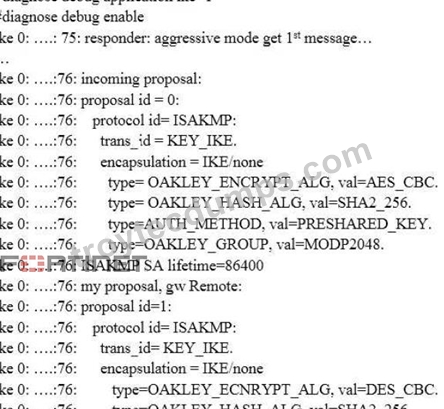

Why didn't the tunnel come up?
- A. IKE mode configuration is not enabled in the remote IPsec gateway.
- B. One IPsec gateway is using main mode, while the other IPsec gateway is using aggressive mode.
- C. The remote gateway's Phase-1 configuration does not match the local gateway's phase-1 configuration.
- D. The remote gateway's Phase-2 configuration does not match the local gateway's phase-2 configuration.
Answer: C
NEW QUESTION # 12
View the IPS exit log, and then answer the question below.
What is the status of IPS on this FortiGate?
- A. IPS daemon experienced a crash.
- B. IPS engine memory consumption has exceeded the model-specific predefined value.
- C. All IPS-related features have been disabled in FortiGate's configuration.
- D. There are communication problems between the IPS engine and the management database.
Answer: C
NEW QUESTION # 13
One firewall policy in an enterprise firewall is essentially used for IPS.
Which configuration must the administrator check in this firewall policy to validate optimum performance for IPS?
- A. set offload enable
- B. set inspection-mode proxy
- C. set np-acceleration enable
- D. set cp-accel-mode enable
Answer: C
NEW QUESTION # 14
Refer to the exhibits.

The Administrators section of a root FortiGate device and the Security Fabric Settings section of a downstream FortiGate device are shown.
When prompted to sign in with Security Fabric in the downstream FortiGate device, a user enters the AdminSSO credentials.
What is the next status for the user?
- A. The user accesses the downstream FortiGate with super_admin privileges.
- B. The user is prompted to create an SSO administrator account for AdminSSO.
- C. The user accesses the downstream FortiGate with super_admin_readonly privileges.
- D. The user receives an authentication failure message.
Answer: C
Explanation:
From theRoot FortiGate - System Administrator Configurationexhibit:
# TheAdminSSOaccount has thesuper_admin_readonlyrole.
From theDownstream FortiGate - Security Fabric Settingsexhibit:
# TheSecurity Fabric roleis set toJoin Existing Fabric, meaning it will authenticate with the root FortiGate.
#SAML Single Sign-On (SSO) is enabled, and thedefault admin profileis set tosuper_admin_readonly.
When theAdminSSOuser logs into the downstream FortiGate usingSSO, the authentication request is sent to the root FortiGate, where AdminSSO hassuper_admin_readonlypermissions. Since the downstream FortiGate inherits this permission through the Security Fabric configuration, the user will be granted super_admin_readonlyaccess.
NEW QUESTION # 15
Refer to the exhibit, which shows partial outputs from two routing debug commands.
Which change must an administrator make on FortiGate to route web traffic from internal users to the internet, using ECMP?
- A. Set snat-route-change to enable.
- B. Set the priority of the static default route using port1 to 10.
- C. Set preserve-session-route to enable.
- D. Set the priority of the static default route using port2 to 1.
Answer: B
NEW QUESTION # 16
Which two configuration settings change the behavior for content-inspected traffic while FortiGate is in conserve mode? (Choose two.)
- A. IPS failopen
- B. mem failopen
- C. UTM failopen
- D. AV failopen
Answer: A,D
NEW QUESTION # 17
Refer to the exhibit, which shows a network diagram.
An administrator would like to modify the MED value advertised from FortiGate_1 to a BGP neighbor in the autonomous system 30.
What must the administrator configure on FortiGate_1 to implement this?
- A. distribute-list-out
- B. route-map-out
- C. network-import-check
- D. prefix-list-out
Answer: B
Explanation:
TheMulti-Exit Discriminator (MED)is aBGP attributeused to influence the preferred path for incoming traffic from an external autonomous system (AS). The diagram shows that FortiGate_1 advertisesMED 200, while FortiGate_2 advertisesMED 300, meaningthe ISP will prefer the route through FortiGate_1because alower MED is preferredin BGP.
To modify theMED valueon FortiGate_1 for routes advertised to AS 30, the administrator must configure a route-map-out. A route map canmatch specific routesandset the MED valuebefore sending them to the BGP neighbor.
NEW QUESTION # 18
An administrator needs to install an IPS profile without triggering false positives that can impact applications and cause problems with the user's normal traffic flow. Which action can the administrator take to prevent false positives on IPS analysis?
- A. Use an IPS profile with action monitor, however, the administrator must be aware that this can compromise network integrity.
- B. Install missing or expired SSUTLS certificates on the client PC to prevent expected false positives.
- C. Enable Scan Outgoing Connections to avoid clicking suspicious links or attachments that can deliver botnet malware and create false positives.
- D. Use the IPS profile extension to select an operating system, protocol, and application for all the network internal services and users to prevent false positives.
Answer: D
Explanation:
False positives in Intrusion Prevention System (IPS) analysis can disrupt legitimate traffic and negatively impact user experience. To reduce false positives while maintaining security, administrators can:
Use IPS profile extensions to fine-tune the settings based on the organization's environment.
Select the correct operating system, protocol, and application types to ensure that IPS signatures match the network's actual traffic patterns, reducing false positives.
Customize signature selection based on the network's specific services, filtering out unnecessary or irrelevant signatures.
NEW QUESTION # 19
View the exhibit, which contains a session entry, and then answer the question below.
What statements are correct regarding this session? (Choose two.)
- A. This session terminates or originates in the FortiGate device.
- B. It is a TCP session in SYN_SENT state.
- C. It is an UDP session that has seen traffic flow both ways.
- D. This is a TCP session that was blocked by firewall policy ID 0.
Answer: A,B
NEW QUESTION # 20
View the exhibit, which contains the partial output of the IKE real-time debug from three different FortiGates, then answer the question below.
Which FortiGate(s) are configured as ADVPN hubs?
- A. FortiGate 2 only
- B. FortiGate 3 only
- C. FortiGate 1 and 2
- D. FortiGate 1 only
Answer: D
NEW QUESTION # 21
When does a RADIUS server send an Access-Challenge packet?
- A. The user account is not found in the server.
- B. The server requires more information from the user, such as the token code for two-factor authentication.
- C. The user credentials are wrong.
- D. The server does not have the user credentials yet.
Answer: B
NEW QUESTION # 22
An administrator must enable direct communication between multiple spokes in a company's network. Each spoke has more than one internet connection.
The requirement is for the spokes to connect directly without passing through the hub, and for the links to automatically switch to the best available connection.
How can this automatic detection and optimal link utilization between spokes be achieved?
- A. Utilize ADVPN 2.0 to facilitate dynamic direct tunnels and automatic link optimization.
- B. Implement SD-WAN policies at the hub to manage spoke link quality.
- C. Establish static VPN tunnels between spokes with predefined backup routes.
- D. Set up OSPF routing over static VPN tunnels between spokes.
Answer: A
Explanation:
ADVPN (Auto-Discovery VPN) 2.0is the optimal solution for enablingdirect spoke-to-spoke communicationwithout passing through the hub, while also allowingautomatic link selectionbased on quality metrics.
#Dynamic Direct Tunnels:
# ADVPN 2.0 allowsspokes to establish direct IPsec tunnels dynamicallybased on traffic patterns, reducing latency and improving performance.
# Unlike static VPNs, spokes do not need to pre-configure tunnels for each other.
#Automatic Link Optimization:
# ADVPN 2.0monitors the qualityof multiple internet connections on each spoke.
# It automatically switches to the best available connection when the primary linkdegrades or fails.
# This is achieved by dynamically adjusting BGP-based routing or leveraging SD-WAN integration.
NEW QUESTION # 23
Refer to the exhibit, which contains the output of a web filtering diagnose command.

Which statement explains why the cache statistics are all zeros?
- A. There are no users making web requests.
- B. FortiGate is using flow-based inspection which does not use the cache.
- C. The FortiGate web filter cache is disabled in the FortiGate configuration.
- D. The administrator has reallocated the cache memory to a separate process.
Answer: C
NEW QUESTION # 24
What action can be taken on a FortiGate to block traffic using IPS protocol decoders, focusing on network transmission patterns and application signatures?
- A. Configure a web filter profile in flow mode.
- B. Use the DNS filter to block application signatures and protocol decoders.
- C. Enable application detection-based SD-WAN rules.
- D. Use application control to limit non-URL-based software handling.
Answer: D
Explanation:
FortiGate's IPS protocol decoders analyze network transmission patterns and application signatures to identify and block malicious traffic. Application Control is the feature that allows FortiGate to detect, classify, and block applications based on their behavior and signatures, even when they do not rely on traditional URLs.
Application Control works alongside IPS protocol decoders to inspect packet payloads and enforce security policies based on recognized application behaviors. It enables granular control over non-URL-based applications such as P2P traffic, VoIP, messaging apps, and other non- web-based protocols that IPS can identify through protocol decoders. IPS and Application Control together can detect evasive or encrypted applications that might bypass traditional firewall rules.
NEW QUESTION # 25
Refer to the exhibits.


The exhibits show a network diagram, the output from the command config system ha, and a firewall policy.
What source MAC address does the web server detect when a user accesses it?
- A. The virtual MAC address of FortiGate A.
- B. The physical MAC address of FortiGate A.
- C. The physical MAC address of FortiGate B.
- D. The virtual MAC address of FortiGate B.
Answer: C
NEW QUESTION # 26
Which troubleshooting step is applicable when investigating antivirus and IPS update issues on FortiGate?
- A. Verify outbound ICMP connectivity.
- B. Use the diagnose debug rating command to check active servers.
- C. Use the alternate service port 8888.
- D. Validate DNS resolution for update.fortiguard.net.
Answer: D
NEW QUESTION # 27
What are two functions of automation stitches? (Choose two.)
- A. Automation stitches can be created to run diagnostic commands and attach the results to an email message when CPU or memory usage exceeds specified thresholds.
- B. Automation stitches can be configured on any FortiGate device in a Security Fabric environment.
- C. An automation stitch configured to execute actions sequentially can take parameters from previous actions as input for the current action.
- D. An automation stitch configured to execute actions in parallel can be set to insert a specific delay between actions.
Answer: A,C
NEW QUESTION # 28
View the partial crashlog output, and then answer the question below.
# diagnose debug crashlog read
2017-04-20 16:23:10 <00114> IPS enter fail open mode: engines=21 socketsize=123425682
2017-04-20 16:23:10 sessionact=pass
2017-04-20 16:24:09 <00114> IPS exit fail open mode
Which of the following statements are true regarding this FortiGate's fail-open configuration? (Choose two.)
- A. FortiGate was dropping traffic while fail-open mode was active.
- B. FortiGate was passing traffic while fail-open mode was active.
- C. Fail-open is enabled in FortiGate's global IPS configuration.
- D. Fail-open is disabled in FortiGate's global IPS configuration.
Answer: B,C
NEW QUESTION # 29
Refer to the exhibit, which shows an enterprise network connected to an internet service provider.
The administrator must configure the BGP section of FortiGate A to give internet access to the enterprise network.
Which command must the administrator use to establish a connection with the internet service provider?
- A. config redistribute ospf
- B. config redistribute bgp
- C. config router route-map
- D. config neighbor
Answer: D
Explanation:
In BGP (Border Gateway Protocol), a neighbor (peer) configuration is required to establish a connection between two BGP routers. Since FortiGate A is connecting to the ISP (Autonomous System 10) from AS 30, the administrator must define the ISP's BGP router as a neighbor.
The config neighbor command is used to:
Define the ISP's IP address as a BGP peer
Specify the remote AS (AS 10 in this case)
Allow BGP route exchanges between FortiGate A and the ISP
NEW QUESTION # 30
Refer to the exhibit, which shows a partial web filter profile configuration.

Which action will FortiGate take if a user attempts to access www.dropbox.com, which is categorized as File Sharing and Storage?
- A. FortiGate will block the connection, based on the FortiGuard category based filter configuration.
- B. FortiGate will block the connection as an invalid URL.
- C. FortiGate will allow the connection, based onthe URL Filter configuration.
- D. FortiGate will exempt the connection, based on the Web Content Filter configuration.
Answer: C
NEW QUESTION # 31
Refer to the exhibit, which shows a command output.
FortiGate_A and FortiGate_B are members of an FGSP cluster in an enterprise network.
While testing the cluster using the ping command, the administrator monitors packet loss and found that the session output on FortiGate_B is as shown in the exhibit.
What could be the cause of this output on FortiGate_B?
- A. FortiGate_B is configured in passive mode.
- B. FortiGate_A and FortiGate_B have the same standalone-group-id value.
- C. session-pickup-connectionless is set to disable on FortiGate_B.
- D. The session synchronization is encrypted.
Answer: C
Explanation:
TheFortinet FGSP (FortiGate Session Life Support Protocol) clusterallows session synchronization betweentwo FortiGate devicesto provide seamless failover. However,ICMP (ping) is a connectionless protocol, and by default, FortiGate does not synchronize connectionless sessions unless explicitly enabled.
In the exhibit:
# The commandget system session list | grep icmponFortiGate_Breturnsno output, meaning that ICMP sessions arenot being synchronizedfrom FortiGate_A.
# Ifsession-pickup-connectionlessis disabled,FortiGate_B will not receive ICMP sessions, causingpacket lossduring failover.
NEW QUESTION # 32
Which two statements about an auxiliary session are true? (Choose two.)
- A. With the auxiliary session setting enabled, two sessions will be created in case of routing change.
- B. With the auxiliary session disabled, only auxiliary sessions will be offloaded.
- C. With the auxiliary session setting disabled, for each traffic path, FortiGate will use the same auxiliary session.
- D. With the auxiliary session setting enabled, ECMP traffic is accelerated to the NP6 processor.
Answer: B,C
NEW QUESTION # 33
During the maintenance window, an administrator must sniff all the traffic going through a specific firewall policy, which is handled by NP6 interfaces. The output of the sniffer trace provides just a few packets.
Why is the output of sniffer trace limited?
- A. The traffic corresponding to the firewall policy is encrypted.
- B. inspection-mode is set to proxy in the firewall policy.
- C. auto-asic-off load is set to enable in the firewall policy,
- D. The option npudbg is not added in the diagnose sniff packet command.
Answer: C
Explanation:
FortiGate devices withNP6 (Network Processor 6) accelerationoffload traffic directly to hardware, bypassing the CPU for improved performance. Whenauto-asic-offloadis enabled in a firewall policy, most of the trafficdoes not reach the CPU, which means it won't be captured by the standard sniffer trace command.
Since NP6-accelerated traffic is handled entirely in hardware, onlya small portion of initial packets(such as session setup packets or exceptions) might be seen in the sniffer output. To capture all packets, the administrator must disable hardware offloading using:
config firewall policy
edit <policy_ID>
set auto-asic-offload disable
end
Disabling ASIC offload forces traffic to be processed by the CPU, allowing the sniffer tool to capture all packets.
NEW QUESTION # 34
Which two statements about application layer test commands are true? (Choose two.)
- A. Some of them display statistics and configuration information about a feature or process.
- B. They display real-time application debugs.
- C. Some of them can be used to restart an application.
- D. They are used to filter real-time debugs.
Answer: A,C
NEW QUESTION # 35
......
Fortinet FCSS_EFW_AD-7.4 Exam Syllabus Topics:
| Topic | Details |
|---|---|
| Topic 1 |
|
| Topic 2 |
|
| Topic 3 |
|
| Topic 4 |
|
| Topic 5 |
|
FCSS_EFW_AD-7.4 Actual Questions and Braindumps: https://actualtests.troytecdumps.com/FCSS_EFW_AD-7.4-troytec-exam-dumps.html