

Guaranteed Accomplishment with Newest Sep-2025 FREE CompTIA CAS-005
Use Valid New Free CAS-005 Exam Dumps & Answers
CompTIA CAS-005 Exam Syllabus Topics:
| Topic | Details |
|---|---|
| Topic 1 |
|
| Topic 2 |
|
| Topic 3 |
|
| Topic 4 |
|
NEW QUESTION # 112
As part of a security audit in the software development life cycle, a product manager must demonstrate and provide evidence of a complete representation of the code and modules used within the production-deployed application prior to the build. Which of the following best provides the required evidence?
- A. Static application security testing
- B. Software composition analysis
- C. Interactive application security testing
- D. Runtime application inspection
Answer: B
Explanation:
Comprehensive and Detailed In-Depth Explanation:
* Software Composition Analysis (SCA) is the best method for identifying all components, dependencies, and open-source libraries used in an application. It ensures that organizations track and manage vulnerabilities in third-party code before deployment.
* SCA tools generate a Software Bill of Materials (SBOM), which provides a full representation of the code and modules used in the application.
* Other options:
* Static Application Security Testing (SAST) (C) checks for vulnerabilities but does not map dependencies.
* Interactive Application Security Testing (IAST) (D) works at runtime, not before deployment.
* Runtime Application Self-Protection (RASP) (B) works while the application is running.
NEW QUESTION # 113
Operational technology often relies upon aging command, control, and telemetry subsystems that were created with the design assumption of:
- A. communicating over distributed environments
- B. an available EtherneVIP network stack for flexibility.
- C. anticipated eavesdropping from malicious actors.
- D. operating in an isolated/disconnected system.
- E. untrustworthy users and systems being present.
Answer: D
Explanation:
Comprehensive and Detailed Step by Step Explanation:
Understanding the Scenario: The question focuses on the historical design assumptions behind older operational technology (OT)systems, particularly in the context of command, control, and telemetry.
Analyzing the Answer Choices:
A: operating in an isolated/disconnected system: This is the most accurate assumption for many legacy OT systems. Historically, these systems weredesigned to operate in air-gapped environments, completely isolated from external networks (including the internet).
Reference: This aligns with the historical evolution of OT security. Initially, security was based on physical isolation rather than network security controls. This is a common topic in CASP+ discussions on OT security challenges.
B: communicating over distributed environments: While OT systems can be distributed, the core design assumption, especially for older systems, wasn't centered around interconnectivity in the way modern IT systems are.
C: untrustworthy users and systems being present: This is a more modern security principle (Zero Trust).
Older OT systems often operated under a model of implicit trust within their isolated environment.
D: an available EtherneVIP network stack for flexibility: Ethernet/IP is a relatively newer industrial protocol.
Older OT systems often used proprietary or less flexible communication protocols. Also, there is no such thing as EtherneVIP.
E: anticipated eavesdropping from malicious actors: While security was a concern, the primary threat model for older, isolated OT systems didn't heavily emphasize external malicious actors due to the assumed isolation.
Why A is the Correct Answer:
Air Gap: The concept of an air gap (physical isolation) was the cornerstone of security for many legacy OT systems. These systems were not connected to the internet or corporate networks, making them less susceptible to remote attacks.
Legacy Protocols: Older OT systems often used proprietary or serial communication protocols, not designed for internet connectivity.
Implicit Trust: Within the isolated environment, there was often an assumption of trust among the connected components.
CASP+ Relevance: The challenges of securing legacy OT systems, especially in the face of increasing connectivity, are a key area of focus in CASP+. Understanding the historical context and the shift in security paradigms is crucial.
Modern OT Security Considerations (Elaboration):
Convergence: Today, the lines between IT and OT are blurring. OT systems are increasingly connected to corporate networks and the internet, necessitating a shift from isolation-based security to a more comprehensive approach.
Threat Landscape: Modern OT systems face a wider range of threats, including targeted attacks from sophisticated actors.
Security Controls: Modern OT security involves implementing network segmentation, intrusion detection, access controls, and other measures to protect against these evolving threats.
In conclusion, the primary design assumption for many older OT systems was that they would operate in isolated or disconnected environments. This historical context is important for understanding the security challenges faced by organizations today as they integrate these legacy systems into modern, connected environments. This is a core concept discussed in CASP+ in the context of OT security and risk management.
NEW QUESTION # 114
A security analyst is performing a review of a web application. During testing as a standard user, the following error log appears:
Error Message in Database Connection
Connection to host USA-WebApp-Database failed
Database "Prod-DB01" not found
Table "CustomerInfo" not found
Please retry your request later
Which of the following best describes the analyst's findings and a potential mitigation technique?
- A. The findingsindicate unsecure references. All potential user input needs to be properly sanitized.
- B. The findings indicate unsecure protocols. All cookies should be marked as HttpOnly.
- C. The findings indicate a SQL injection. The database needs to be upgraded.
- D. The findings indicate information disclosure. The displayed error message should be modified.
Answer: D
Explanation:
The error message reveals sensitive details (hostnames, database names, table names), constitutinginformation disclosure. This aids attackers in reconnaissance. Mitigation involves modifying the application to display generic error messages (e.g., "An error occurred") instead of specifics.
* Option A:Unsecure references suggest coding flaws, but this is a configuration/output issue, not input sanitization.
* Option B:Unsecure protocols and HttpOnly cookies relate to session security, not error handling.
* Option C:Correct-information disclosure is the issue; generic errors mitigate it.
* Option D:No evidence of SQL injection (e.g., manipulated input); upgrading the database doesn't address disclosure.
Reference:CompTIA SecurityX CAS-005 Domain 2: Security Architecture - Secure Application Design and Error Handling.
NEW QUESTION # 115
A company receives several complaints from customers regarding its website. An engineer implements a parser for the web server logs that generates the following output:
which of the following should the company implement to best resolve the issue?
- A. IDS
- B. NAC
- C. CDN
- D. WAF
Answer: C
Explanation:
The table indicates varying load times for users accessing the website from different geographic locations. Customers from Australia and India are experiencing significantly higher load times compared to those from the United States. This suggests that latency and geographical distance are affecting the website's performance.
A . IDS (Intrusion Detection System): While an IDS is useful for detecting malicious activities, it does not address performance issues related to latency and geographical distribution of content.
B . CDN (Content Delivery Network): A CDN stores copies of the website's content in multiple geographic locations. By serving content from the nearest server to the user, a CDN can significantly reduce load times and improve user experience globally.
C . WAF (Web Application Firewall): A WAF protects web applications by filtering and monitoring HTTP traffic but does not improve performance related to geographical latency.
D . NAC (Network Access Control): NAC solutions control access to network resources but are not designed to address web performance issues.
Implementing a CDN is the best solution to resolve the performance issues observed in the log output.
Reference:
CompTIA Security+ Study Guide
"CDN: Content Delivery Networks Explained" by Akamai Technologies
NIST SP 800-44, "Guidelines on Securing Public Web Servers"
NEW QUESTION # 116
During a security assessment using an CDR solution, a security engineer generates the following report about the assets in me system: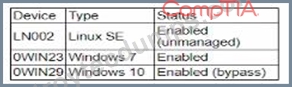
After five days, the EDR console reports an infection on the host 0WIN23 by a remote access Trojan Which of the following is the most probable cause of the infection?
- A. The EDR has an unknown vulnerability that was exploited by the attacker.
- B. OW1N23 uses a legacy version of Windows that is not supported by the EDR
- C. LN002 was not supported by the EDR solution and propagates the RAT
- D. OWIN29 spreads the malware through other hosts in the network: While this could happen, the status indicates OWIN29 is in a bypass mode, which might limit its interactions but does not directly explain the infection on OWIN23.
- E. 0W1N29 spreads the malware through other hosts in the network
Answer: B
Explanation:
OWIN23 is running Windows 7, which is a legacy operating system. Many EDR solutions no longer provide full support for outdated operating systems like Windows 7, which has reached its end of life and is no longer receiving security updates from Microsoft. This makes such systems more vulnerable to infections and attacks, including remote access Trojans (RATs).
A . OWIN23 uses a legacy version of Windows that is not supported by the EDR: This is the most probable cause because the lack of support means that the EDR solution may not fully protect or monitor this system, making it an easy target for infections.
B . LN002 was not supported by the EDR solution and propagates the RAT: While LN002 is unmanaged, it is less likely to propagate the RAT to OWIN23 directly without an established vector.
C . The EDR has an unknown vulnerability that was exploited by the attacker: This is possible but less likely than the lack of support for an outdated OS.
Reference:
CompTIA Security+ Study Guide
NIST SP 800-53, "Security and Privacy Controls for Information Systems and Organizations" Microsoft's Windows 7 End of Support documentation
NEW QUESTION # 117
Embedded malware has been discovered in a popular PDF reader application and is currently being exploited in the wild. Because the supply chain was compromised, this malware is present in versions 10.0 through 10.3 of the software's official versions. The malware is not present in version 10.4.
Since the details around this malware are still emerging, the Chief Information Security Officer has asked the senior security analyst to collaborate with the IT asset inventory manager to find instances of the installed software in order to begin response activities. The asset inventory manager has asked an analyst to provide a regular expression that will identify the affected versions. The software installation entries are formatted as follows:
Reader 10.0
Reader 10.1
Reader 10.2
Reader 10.3
Reader 10.4
Which of the following regular expression entries will accurately identify all the affected versions?
- A. Reader[11[01X.f0-3'
- B. Reader( )[1][0].[0-3:
- C. Reader(*)[1][0].[0-4:
- D. Reader( )[1][0] X.[1-3:
Answer: B
Explanation:
Comprehensive and Detailed Step-by-Step Explanation:
Understand the Question Requirements:The goal is to use a regular expression (regex) to match software versions 10.0 through 10.3, but exclude version 10.4.
Review Regex Syntax:
[ ] indicates a character set (matches any one character in the set).
[0-3] matches any digit between 0 and 3.
\. escapes the period (.) so it matches a literal period instead of acting as a wildcard.
( ) groups parts of the regex together.
Analyze Each Option:
Option A: Reader(*)[1][0].[0-4:
Incorrect. The use of (*) is not valid syntax in this context and [0-4 is incomplete or misformatted.
Option B: Reader[11[01X.f0-3'
Incorrect. This is an invalid regex syntax, mixing character sets and mismatched brackets.
Option C: Reader( )[1][0].[0-3:
Correct. This regex is valid and matches "Reader 10.0", "Reader 10.1", "Reader 10.2", and "Reader 10.3" while excluding "Reader 10.4".
Breakdown:
Reader: Matches the text "Reader".
[1][0]: Matches "10" as a combination of two characters.
\.: Matches the literal period.
[0-3]: Matches any single digit between 0 and 3.
Option D: Reader( )[1][0] X.[1-3:
Incorrect. The syntax X.[1-3 is invalid, and this does not match the required versions.
Conclusion:The regex in Option C correctly identifies all affected versions (10.0, 10.1, 10.2, 10.3) while excluding the unaffected version (10.4).
NEW QUESTION # 118
A user submits a help desk ticket stating then account does not authenticate sometimes. An analyst reviews the following logs for the user:
Which of the following best explains the reason the user's access is being denied?
- A. Account compromise
- B. Time-based access restrictions
- C. incorrectly typed password
- D. Invalid user-to-device bindings
Answer: B
Explanation:
The logs reviewed for the user indicate that access is being denied due to time-based access restrictions. These restrictions are commonly implemented to limit access to systems during specific hours to enhance security. If a user attempts to authenticate outside of the allowed time window, access will be denied. This measure helps prevent unauthorized access during non-business hours, reducing the risk of security incidents.
References:
* CompTIA SecurityX Study Guide: Covers various access control methods, including time-based restrictions, as a means of enhancing security.
* NIST Special Publication 800-53, "Security and Privacy Controls for Information Systems and Organizations": Recommends the use of time-based access restrictions as part of access control policies.
* "Access Control and Identity Management" by Mike Chapple and Aaron French: Discusses the implementation and benefits of time-based access restrictions.
NEW QUESTION # 119
An organization has been using self-managed encryption keys rather than the free keys managed by the cloud provider. The Chief Information Security Officer (CISO) reviews the monthly bill and realizes the self-managed keys are more costly than anticipated. Which of the following should the CISO recommend to reduce costs while maintaining a strong security posture?
- A. Begin using cloud-managed keys on all new resources deployed in the cloud.
- B. Utilize an on-premises HSM to locally manage keys.
- C. Adjust the configuration for cloud provider keys on data that is classified as public.
- D. Extend the key rotation period to one year so that the cloud provider can use cached keys.
Answer: C
Explanation:
Comprehensive and Detailed Step by Step
Understanding the Scenario: The organization is using customer-managed encryption keys in the cloud, which is more expensive than using the cloud provider's free managed keys. The CISO needs to find a way to reduce costs without significantly weakening the security posture.
Analyzing the Answer Choices:
A . Utilize an on-premises HSM to locally manage keys: While on-premises HSMs offer strong security, they introduce additional costs and complexity (procurement, maintenance, etc.). This option is unlikely to reduce costs compared to cloud-based key management.
B . Adjust the configuration for cloud provider keys on data that is classified as public: This is the most practical and cost-effective approach. Data classified as public doesn't require the same level of protection as sensitive data. Using the cloud provider's free managed keys for public data can significantly reduce costs without compromising security, as the data is intended to be publicly accessible anyway.
Reference:
C . Begin using cloud-managed keys on all new resources deployed in the cloud: While this would reduce costs, it's a broad approach that doesn't consider the sensitivity of the data. Applying cloud-managed keys to sensitive data might not be acceptable from a security standpoint.
D . Extend the key rotation period to one year so that the cloud provider can use cached keys: Extending the key rotation period weakens security. Frequent key rotation is a security best practice to limit the impact of a potential key compromise.
Why B is the Correct answer:
Risk-Based Approach: Using cloud-provider-managed keys for public data is a reasonable risk-based decision. Public data, by definition, is not confidential.
Cost Optimization: This directly addresses the CISO's concern about cost, as cloud-provider-managed keys are often free or significantly cheaper.
Security Balance: It maintains a strong security posture for sensitive data by continuing to use customer-managed keys where appropriate, while optimizing costs for less sensitive data.
CASP+ Relevance: This approach demonstrates an understanding of risk management, data classification, and cost-benefit analysis in security decision-making, all of which are important topics in CASP+.
Elaboration on Data Classification:
Data Classification Policy: Organizations should have a clear data classification policy that defines different levels of data sensitivity (e.g., public, internal, confidential, restricted).
Security Controls Based on Classification: Security controls, including encryption key management, should be applied based on the data's classification level.
Cost-Benefit Analysis: Data classification helps organizations make informed decisions about where to invest in stronger security controls and where cost optimization is acceptable.
In conclusion, adjusting the configuration to use cloud-provider-managed keys for data classified as public is the most effective way to reduce costs while maintaining a strong security posture. It's a practical, risk-based approach that aligns with data classification principles and cost-benefit considerations, all of which are important concepts covered in the CASP+ exam objectives.
NEW QUESTION # 120
An organization found a significant vulnerability associated with a commonly used package in a variety of operating systems. The organization develops a registry of software dependencies to facilitate incident response activities. As part of the registry, the organization creates hashes of packages that have been formally vetted. Which of the following attack vectors does this registry address?
Supply chain attack B. Cipher substitution attack C. Side-channel analysis D. On-path attack E. Pass-the-hash attack Explanation:
Comprehensive and Detailed Step by Step Explanation:
Understanding the Scenario: The question describes a proactive security measure where an organization maintains a registry of software dependencies and their corresponding hashes. This registry is used to verify the integrity of software packages.
Analyzing the Answer Choices:
- A. Pass-the-hash attack: This attack involves using a stolen hash of a user's password to authenticate without needing the actual password. It's unrelated to software package integrity.
- B. Supply chain attack: This type of attack involves compromising the software supply chain by injecting malicious code into legitimate software packages.
Reference: CASP+ objectives often emphasize supply chain security due to its growing importance. The scenario directly relates to this type of attack, as the registry helps ensure that software packages haven't been tampered with during the supply chain process. - C. Cipher substitution attack: This is a cryptographic attack focused on replacing ciphertext with a different ciphertext to deduce the key. It's not relevant to the scenario.
- D. Side-channel analysis: This attack involves gathering information from the physical implementation of a system (e.g., timing, power consumption) rather than exploiting the algorithm itself. It's not applicable here.
- E. On-path attack (formerly man-in-the-middle): This attack involves intercepting and potentially altering communication between two parties. While important, it's not theprimary focus of the registry.
Answer: B
Explanation:
Why A is the Correct Answer:
A supply chain attack is exactly what the organization is trying to mitigate. By creating a registry of known- good software packages and their hashes, they can verify that the packages they are using are legitimate and haven't been altered.
If an attacker were to compromise a software package in the supply chain, the hash of the altered package would not match the hash in the organization's registry. This would immediately alert the organization to a potential compromise.
CASP+ Relevance: This aligns with the CASP+ exam objectives, which emphasize the importance of risk management, threat intelligence, and implementing security controls to address various attack vectors, including supply chain risks.
How the Registry Works (Elaboration based on CASP+principles):
Hashing: When a package is vetted, a cryptographic hash function (like SHA-256) is used to generate a unique "fingerprint" (the hash) of the package's contents.
Verification: Before installing or using a package, its hash is calculated and compared to the hash stored in the registry. A match confirms the package's integrity. A mismatch indicates tampering.
Incident Response: If a vulnerability is discovered in a commonly used package, the registry helps the organization quickly identify which systems are affected based on the dependency list and the stored hashes.
In conclusion, maintaining a registry of software dependencies with hashes is a crucial security control that directly addresses the threat of supply chain attacks by ensuring the integrity and authenticity of software packages. The use of hash functions for verification is a common practice in security and is emphasized in the CASP+ material.
NEW QUESTION # 121
A security architect is onboarding a new EDR agent on servers that traditionally do not have internet access. In order for the agent to receive updates and report back to the management console, some changes must be made. Which of the following should the architect do to best accomplish this requirement? (Choose two.)
- A. Create a firewall rule to only allow traffic from the subnet to the internet to fully qualified names that are not identified as malicious by the firewall vendor.
- B. Configure a proxy policy that blocks only lists of known-bad, fully qualified domain names.
- C. Create a firewall rule to only allow traffic from the subnet to the internet via a proxy.
- D. Configure a proxy policy that blocks all traffic on port 443.
- E. Configure a proxy policy that allows only fully qualified domain names needed to communicate to a portal.
- F. Create a firewall rule to only allow traffic from the subnet to the internet via port 443.
Answer: C,E
NEW QUESTION # 122
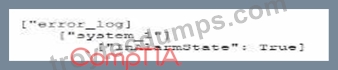
A security administrator needs to automate alerting. The server generates structured log files that need to be parsed to determine whether an alarm has been triggered Given the following code function:
Which of the following is most likely the log input that the code will parse?
- A.

- B.
- C.

- D.

Answer: B
Explanation:
The code function provided in the question seems to be designed to parse JSON formatted logs to check for an alarm state. Option A is a JSON format that matches the structure likely expected by the code. The presence of the "error_log" and "InAlarmState" keys suggests that this is the correct input format.
NEW QUESTION # 123
A systems engineer is configuring a system baseline for servers that will provide email services.
As part of the architecture design, the engineer needs to improve performance of the systems by using an access vector cache, facilitating mandatory access control and protecting against:
- Unauthorized reading and modification of data and programs
- Bypassing application security mechanisms
- Privilege escalation
- interference with other processes
Which of the following is the most appropriate for the engineer to deploy?
- A. Privileged access management
- B. Self-encrypting disks
- C. SELinux
- D. NIPS
Answer: C
Explanation:
The most appropriate solution for the systems engineer to deploy is SELinux (Security-Enhanced Linux).
Mandatory Access Control (MAC): SELinux enforces MAC policies, ensuring that only authorized users and processes can access specific resources. This helps in preventing unauthorized reading and modification of data and programs.
Access Vector Cache: SELinux utilizes an access vector cache (AVC) to improve performance.
The AVC caches access decisions, reducing the need for repetitive policy lookups and thus improving system efficiency.
Security Mechanisms: SELinux provides a robust framework to enforce security policies and prevent bypassing of application security mechanisms. It controls access based on defined policies, ensuring that security measures are consistently applied.
Privilege Escalation and Process Interference: SELinux limits the ability of processes to escalate privileges and interfere with each other by enforcing strict access controls. This containment helps in isolating processes and minimizing the risk of privilege escalation attacks.
NEW QUESTION # 124
A company that uses several cloud applications wants to properly identify:
* All the devices potentially affected by a given vulnerability.
* All the internal servers utilizing the same physical switch.
* The number of endpoints using a particular operating system.Which of the following is the best way to meet the requirements?
- A. SBoM
- B. CASB
- C. GRC
- D. CMDB
Answer: D
Explanation:
Comprehensive and Detailed Explanation:
The requirements demand detailed asset tracking and inventory management. Let's analyze:
* A. SBoM (Software Bill of Materials):Tracks software components, not hardware or network topology.
* B. CASB (Cloud Access Security Broker):Secures cloud apps but doesn't map physical switches or OS counts.
* C. GRC (Governance, Risk, and Compliance):Focuses on risk management, not detailed asset tracking.
NEW QUESTION # 125
Recent repents indicate that a software tool is being exploited Attackers were able to bypass user access controls and load a database. A security analyst needs to find the vulnerability and recommend a mitigation.
The analyst generates the following output: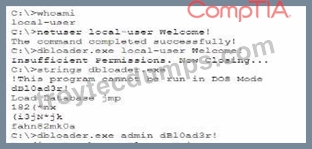
Which of the following would the analyst most likely recommend?
- A. Not allowing users to change their local passwords
- B. Adding additional time to software development to perform fuzz testing
- C. Removing hard coded credentials from the source code
- D. Installing appropriate EDR tools to block pass-the-hash attempts
Answer: C
Explanation:
The output indicates that the software tool contains hard-coded credentials, which attackers can exploit to bypass user access controls and load the database. The most likely recommendation is to remove hard-coded credentials from the source code. Here's why:
* Security Best Practices: Hard-coded credentials are a significant security risk because they can be easily discovered through reverse engineering or simple inspection of the code. Removing them reduces the risk of unauthorized access.
* Credential Management: Credentials should be managed securely using environment variables, secure vaults, or configuration management tools that provide encryption and access controls.
* Mitigation of Exploits: By eliminating hard-coded credentials, the organization can prevent attackers from easily bypassing authentication mechanisms and gaining unauthorized access to sensitive systems.
* References:
* CompTIA Security+ SY0-601 Study Guide by Mike Chapple and David Seidl
* OWASP Top Ten: Insecure Design
* NIST Special Publication 800-53: Security and Privacy Controls for Information Systems and Organizations
NEW QUESTION # 126
A senior security engineer flags me following log file snippet as hawing likely facilitated an attacker's lateral movement in a recent breach: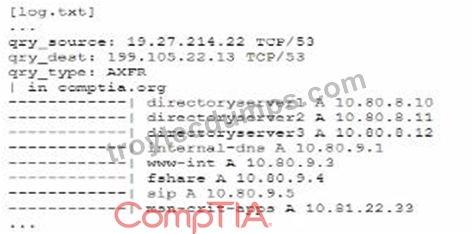
Which of the following solutions, if implemented, would mitigate the nsk of this issue reoccurnnp?
- A. Restricting DNS traffic to UDP'W
- B. Permitting only clients from internal networks to query DNS
- C. Disabling DNS zone transfers
- D. Implementing DNS masking on internal servers
Answer: C
Explanation:
The log snippet indicates a DNS AXFR (zone transfer) request, which can be exploited by attackers to gather detailed information about an internal network's infrastructure. Disabling DNS zone transfers is the best solution to mitigate this risk. Zone transfers should generally be restricted to authorized secondary DNS servers and not be publicly accessible, as they can reveal sensitive network information that facilitates lateral movement during an attack.
Reference:
CompTIA SecurityX Study Guide: Discusses the importance of securing DNS configurations, including restricting zone transfers.
NIST Special Publication 800-81, "Secure Domain Name System (DNS) Deployment Guide": Recommends restricting or disabling DNS zone transfers to prevent information leakage.
NEW QUESTION # 127
Which of the following best describes the reason a network architect would enable forward secrecy on all VPN tunnels?
- A. The business requirements state that confidentiality is a critical success factor.
- B. This process is a requirement to enable hardware-accelerated cryptography.
- C. Modern cryptographic protocols list this process as a prerequisite for use.
- D. This process reduces the success of attackers performing cryptanalysis.
Answer: D
Explanation:
Forward secrecy, also known as perfect forward secrecy, is a feature of certain key agreement protocols that ensures session keys will not be compromised even if the server's private key is compromised in the future.
By enabling forward secrecy on VPN tunnels, each session uses a unique key, and these keys are not derived from a common master key. This means that even if an attacker obtains the server's private key, they cannot decrypt past sessions, thereby significantly reducing the effectiveness of cryptanalysis attacks.
NEW QUESTION # 128
A security analyst discovered requests associated with IP addresses known for born legitimate 3nd bot-related traffic. Which of the following should the analyst use to determine whether the requests are malicious?
- A. User-agent string
- B. Byte length of the request
- C. HTML encoding field
- D. Web application headers
Answer: A
Explanation:
The user-agent string can provide valuable information to distinguish between legitimate and bot-related traffic. It contains details about the browser, device, and sometimes the operating system of the client making the request.
Why Use User-Agent String?
* Identify Patterns: User-agent strings can help identify patterns that are typical of bots or legitimate users.
* Block Malicious Bots: Many bots use known user-agent strings, and identifying these can help block malicious requests.
* Anomalies Detection: Anomalous user-agent strings can indicate spoofing attempts or malicious activity.
Other options provide useful information but may not be as effective for initial determination of the nature of the request:
* B. Byte length of the request: This can indicate anomalies but does not provide detailed information about the client.
* C. Web application headers: While useful, they may not provide enough distinction between legitimate and bot traffic.
* D. HTML encoding field: This is not typically used for identifying the nature of the request.
References:
* CompTIA SecurityX Study Guide
* "User-Agent Analysis for Security," OWASP
* NIST Special Publication 800-94, "Guide to Intrusion Detection and Prevention Systems (IDPS)"
NEW QUESTION # 129
Which of the following key management practices ensures that an encryption key is maintained within the organization?
- A. Encrypting using a key stored in an on-premises hardware security module
- B. Encrypting using a key escrow process for storage of the encryption key
- C. Encrypting using server-side encryption capabilities provided by the cloud provider
- D. Encrypting using encryption and key storage systems provided by the cloud provider
Answer: A
Explanation:
Comprehensive and Detailed Step by Step
Understanding the Scenario: The question is about ensuring that an organization retains control over its encryption keys. It focuses on different key storage and management methods.
Analyzing the Answer Choices:
A . Encrypting using a key stored in an on-premises hardware security module (HSM): This is the best option for maintaining complete control over encryption keys. An HSM is a dedicated, tamper-resistant hardware device specifically designed for secure key storage and cryptographic operations. Storing keys on-premises within an HSM ensures the organization has exclusive access.
Reference:
B . Encrypting using server-side encryption capabilities provided by the cloud provider: With server-side encryption, the cloud provider typically manages the encryption keys. This means the organization is relinquishing some control over the keys.
C . Encrypting using encryption and key storage systems provided by the cloud provider: Similar to option B, using cloud-provider-managed key storage systems means the organization doesn't have full, exclusive control over the keys.
D . Encrypting using a key escrow process for storage of the encryption key: Key escrow involves entrusting a third party with a copy of the encryption key. This introduces a potential security risk, as the organization no longer has sole control over the key. Also, the key is not maintained within the organization.
Why A is the Correct answer:
Control: On-premises HSMs provide the highest level of control over encryption keys. The organization has physical and logical control over the HSM and the keys stored within it.
Security: HSMs are designed to be tamper-resistant and protect keys from unauthorized access, even if the surrounding systems are compromised.
Compliance: In some industries, regulatory requirements may mandate that organizations maintain direct control over their encryption keys. On-premises HSMs can help meet these requirements.
CASP+ Relevance: HSMs, key management, and data encryption are fundamental topics in CASP+. The exam emphasizes understanding the security implications of different key management approaches.
Elaboration on Key Management Principles:
Key Lifecycle Management: Proper key management involves managing the entire lifecycle of a key, from generation and storage to rotation and destruction.
Separation of Duties: It's generally a good practice to separate the roles of key management and data encryption to enhance security.
Access Control: Strict access controls should be in place to limit who can access and use encryption keys.
In conclusion, using an on-premises HSM for key storage is the best way to ensure that an organization maintains control over its encryption keys. It provides the highest level of security and control, aligning with best practices in cryptography and key management as emphasized in the CASP+ exam objectives.
NEW QUESTION # 130
A systems administrator wants to reduce the number of failed patch deployments in an organization. The administrator discovers that system owners modify systems or applications in an ad hoc manner. Which of the following is the best way to reduce the number of failed patch deployments?
- A. Quality assurance
- B. Situational awareness
- C. Change management
- D. Compliance tracking
Answer: C
Explanation:
To reduce the number of failed patch deployments, the systems administrator should implement a robust change management process. Change management ensures that all modifications to systems or applications are planned, tested, and approved before deployment. This systematic approach reduces the risk of unplanned changes that can cause patch failures and ensures that patches are deployed in a controlled and predictable manner.
Reference:
CompTIA SecurityX Study Guide: Emphasizes the importance of change management in maintaining system integrity and ensuring successful patch deployments.
ITIL (Information Technology Infrastructure Library) Framework: Provides best practices for change management in IT services.
"The Phoenix Project" by Gene Kim, Kevin Behr, and George Spafford: Discusses the critical role of change management in IT operations and its impact on system stability and reliability.
NEW QUESTION # 131
A pharmaceutical lab hired a consultant to identify potential risks associated with Building 2, a new facility that is under construction. The consultant received the IT project plan, which includes the following VLAN design: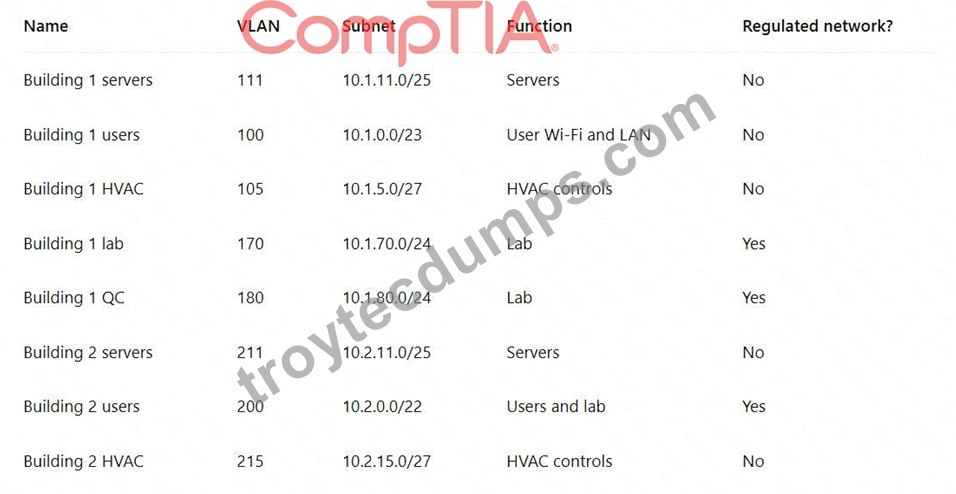
Which of the following TTPs should the consultant recommend be addressed first?
- A. Lateral movement
- B. Privilege escalation
- C. Unauthorized execution
- D. Zone traversal
Answer: D
Explanation:
* Theregulated lab environment (Yes)shares the same VLAN (10.2.0.0/22) withusers, creatingzone traversalrisk from unregulated zones to sensitive datanetworks.
* This allows pivoting and lateral movement from non-regulated user devices into regulated lab environments - a classiczone boundary violation.
* Zone traversal should be mitigated with segmentation and firewall enforcement.
* FromCAS-005, Domain 2: Risk Management and Mitigation Strategies:
* "Zone traversal occurs when segmentation boundaries are misconfigured or merged, leading to regulatory and risk compliance failures." Reference:CAS-005 Study Guide, Chapter 8: Network Segmentation and Zoning, pg. 152-154
NEW QUESTION # 132
SIMULATION
[Security Architecture]
A security engineer needs to review the configurations of several devices on the network to meet the following requirements:
* The PostgreSQL server must only allow connectivity in the 10.1.2.0/24 subnet.
* The SSH daemon on the database server must be configured to listen
to port 4022.
* The SSH daemon must only accept connections from a Single
workstation.
* All host-based firewalls must be disabled on all workstations.
* All devices must have the latest updates from within the past eight
days.
* All HDDs must be configured to secure data at rest.
* Cleartext services are not allowed.
* All devices must be hardened when possible.
Instructions:
Click on the various workstations and network devices to review the posture assessment results. Remediate any possible issues or indicate that no issue is found.
Click on Server A to review output data. Select commands in the appropriate tab to remediate connectivity problems to the pOSTGREsql DATABASE VIA ssh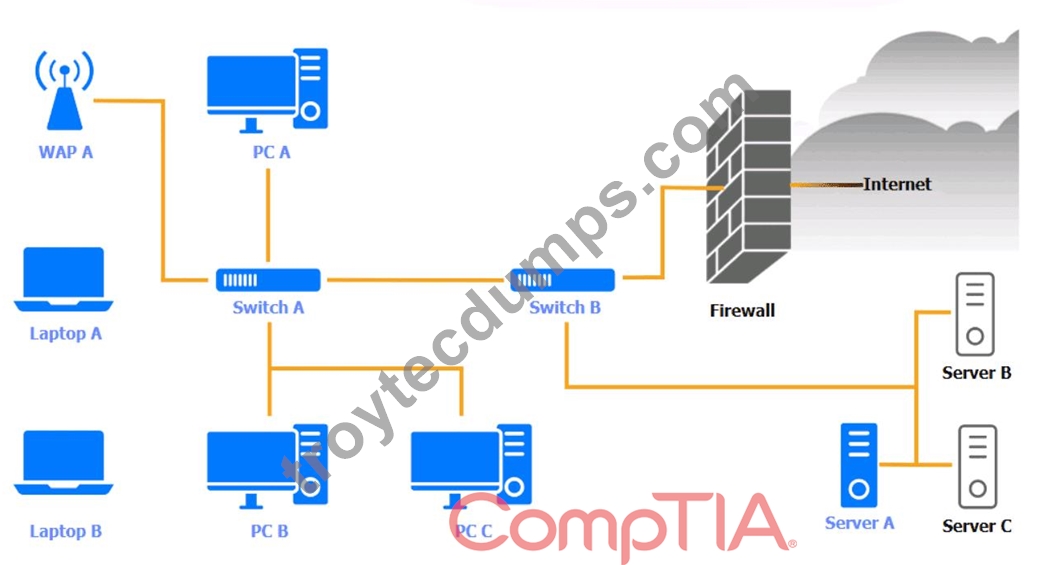
WAP A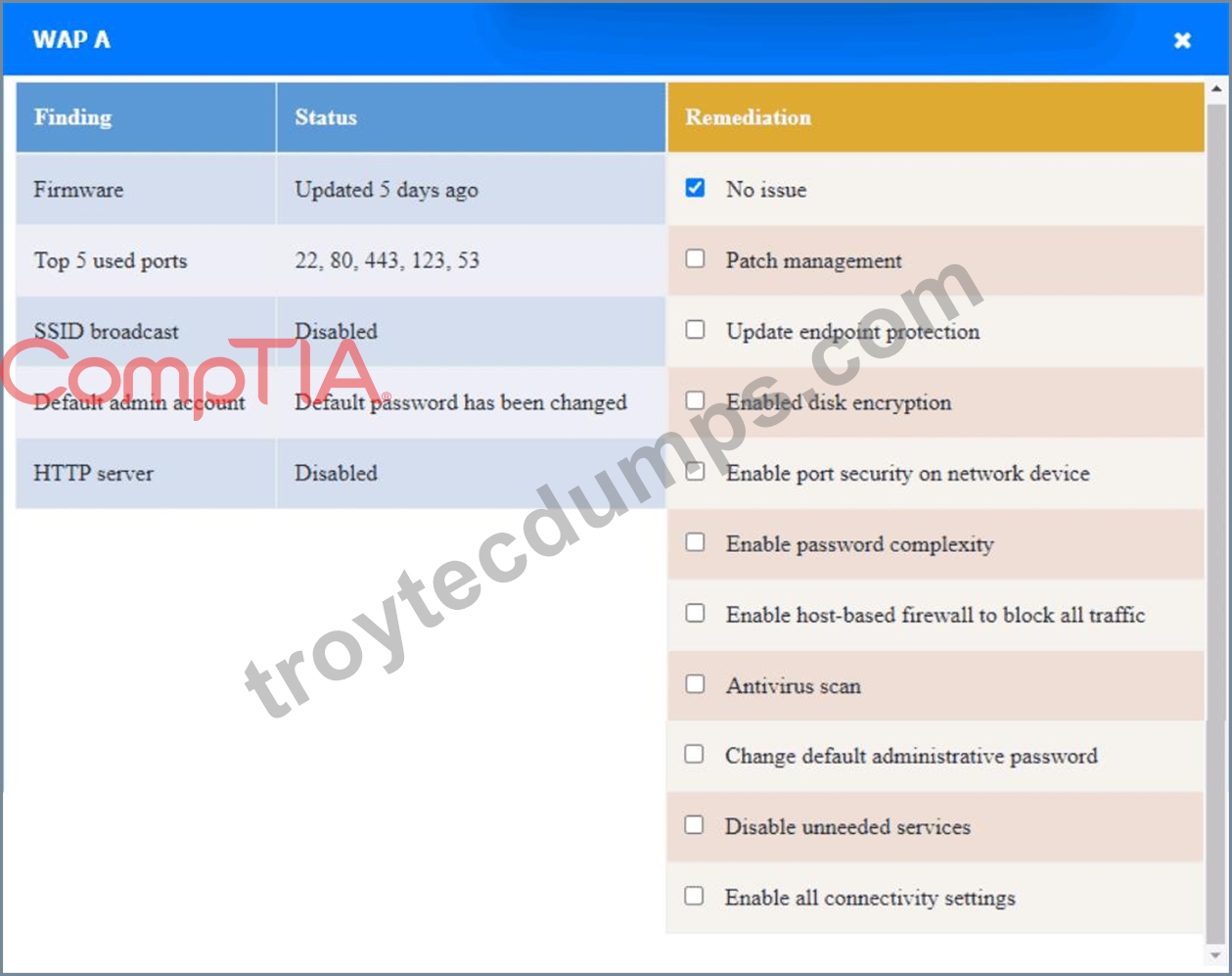
PC A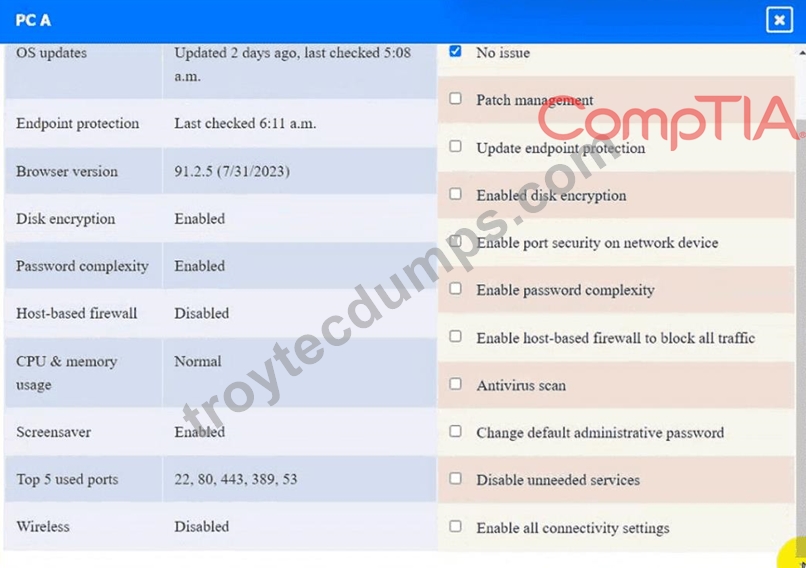
Laptop A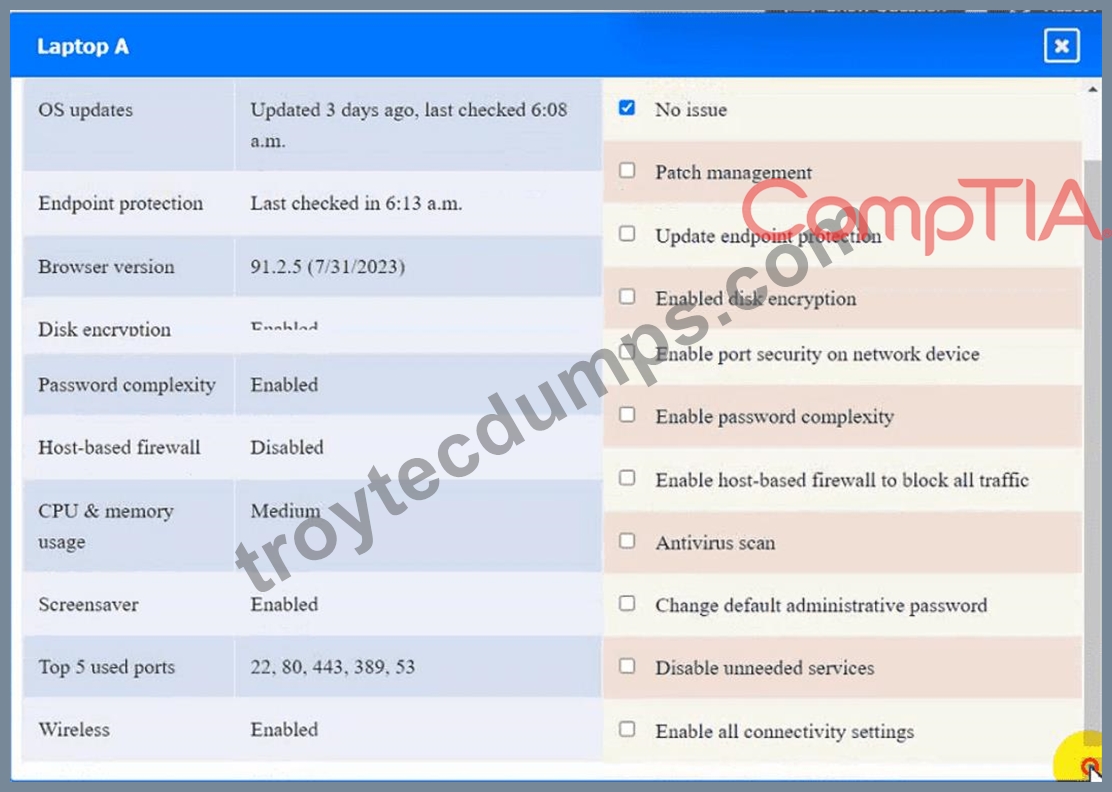
Switch A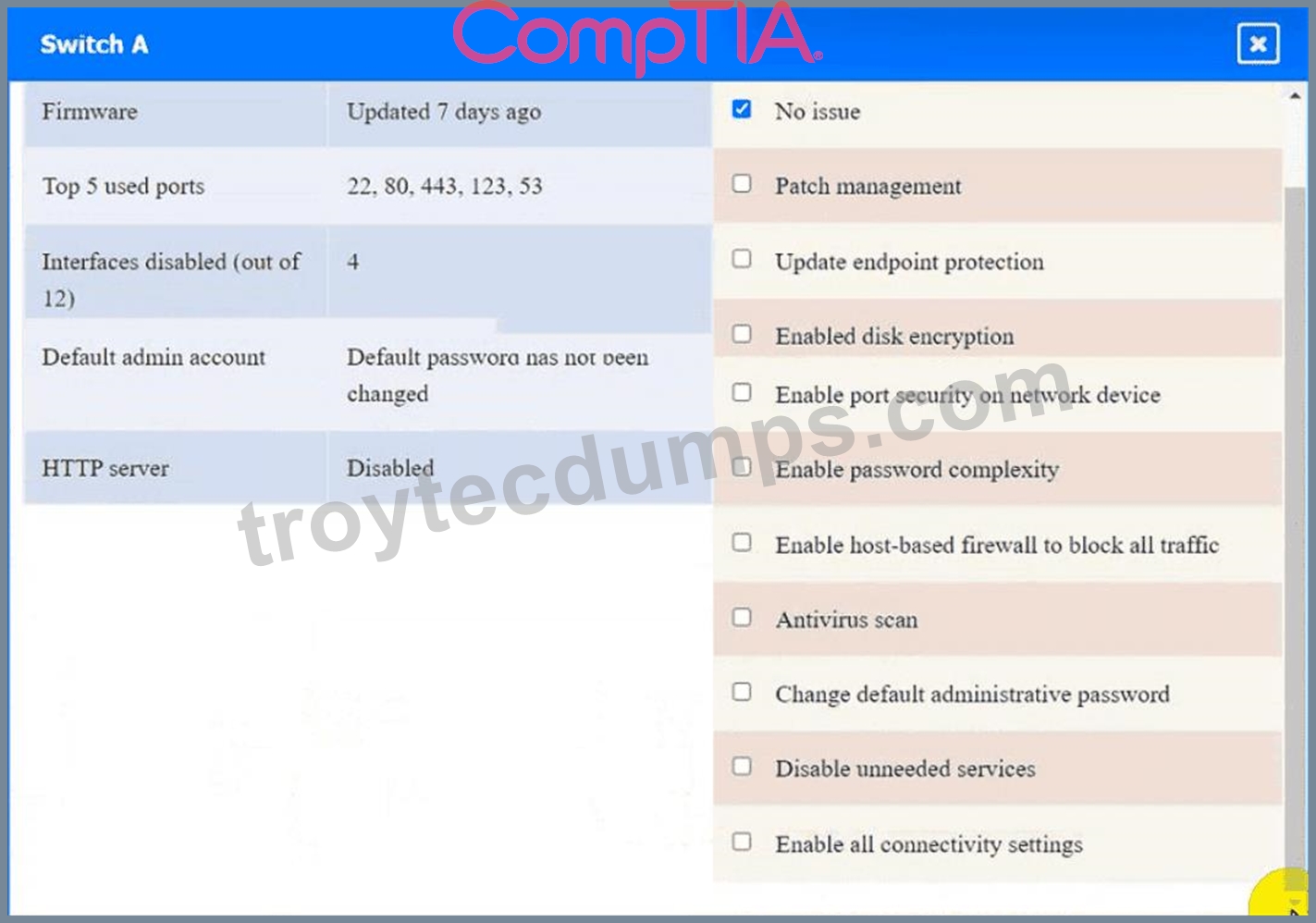
Switch B: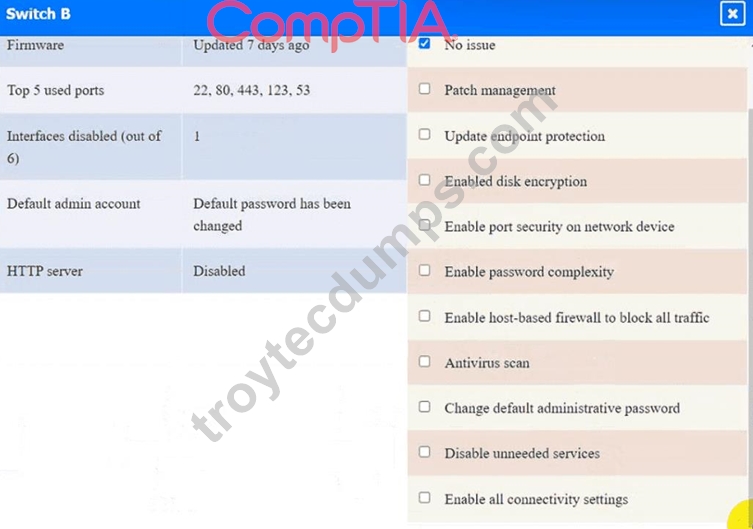
Laptop B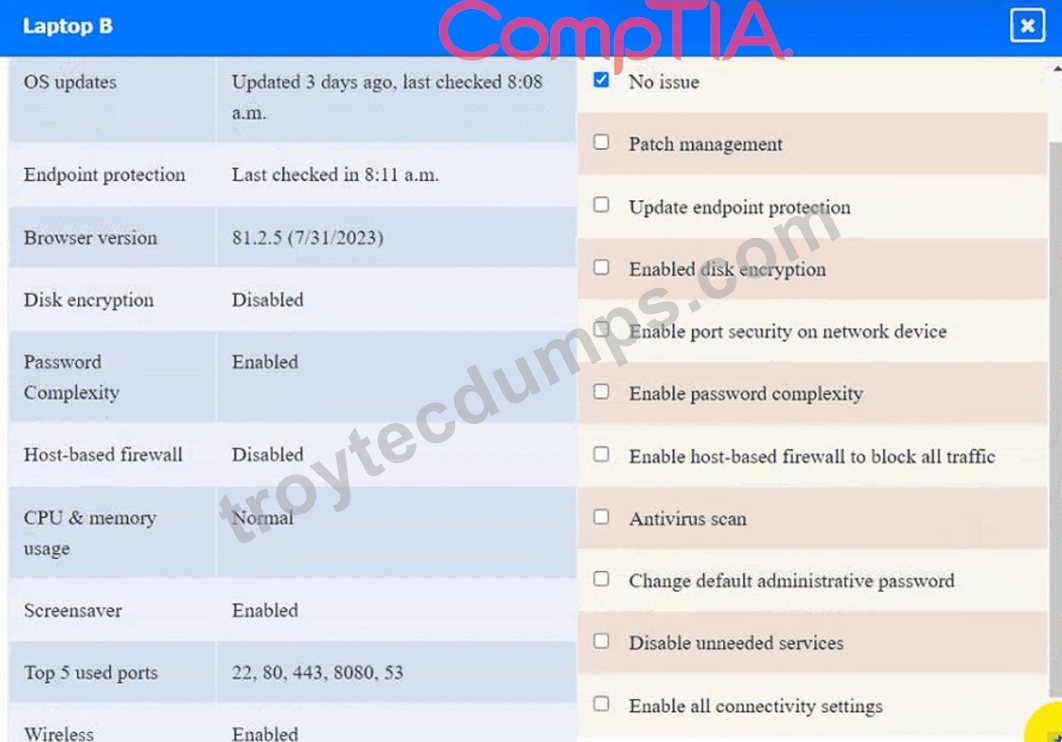
PC B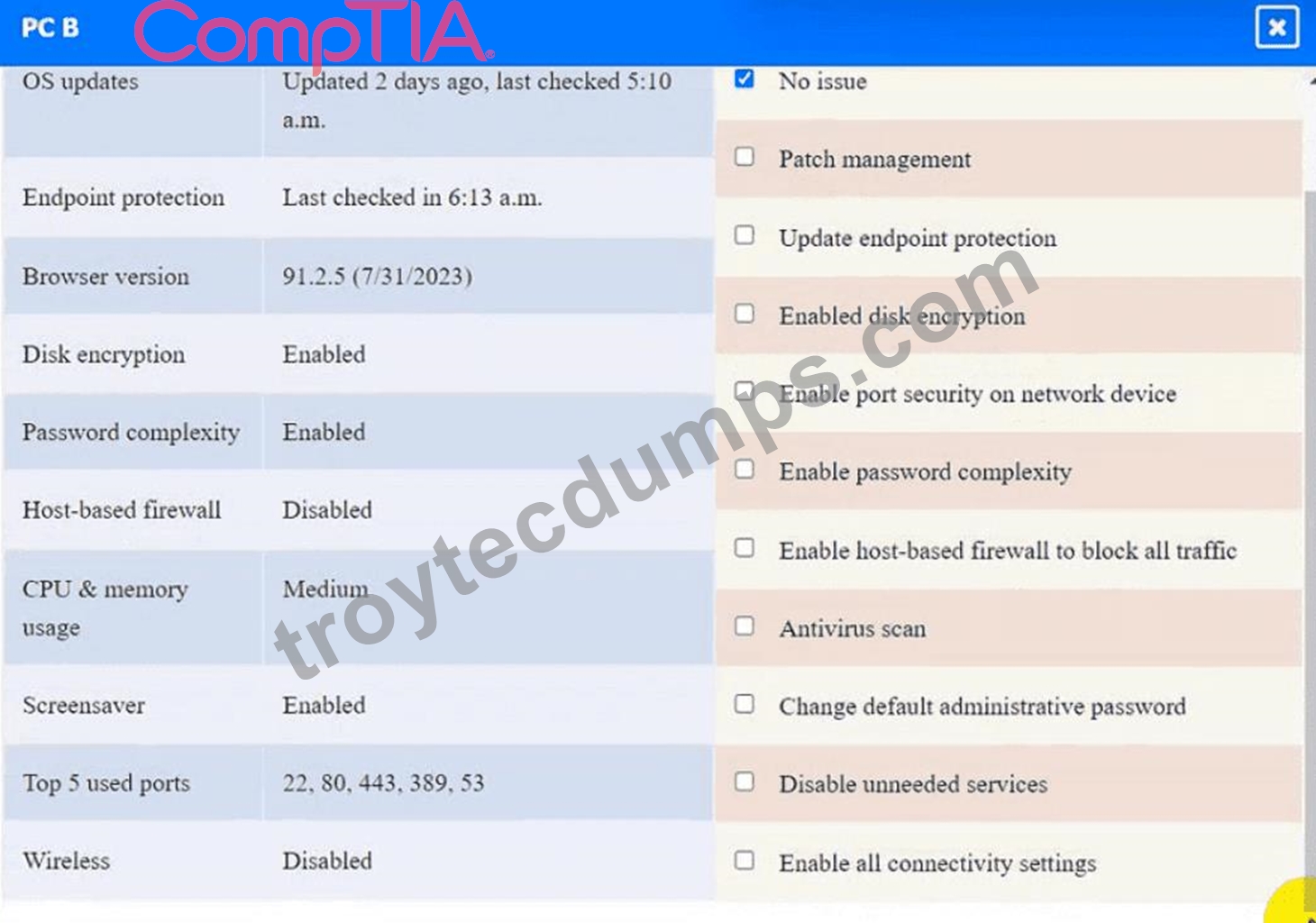
PC C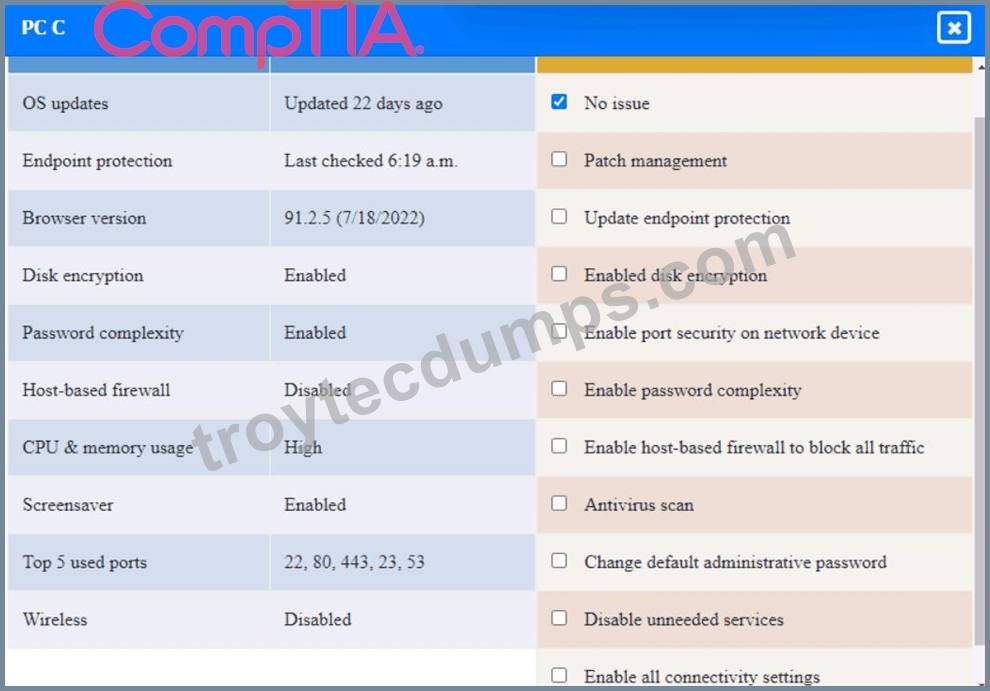
Server A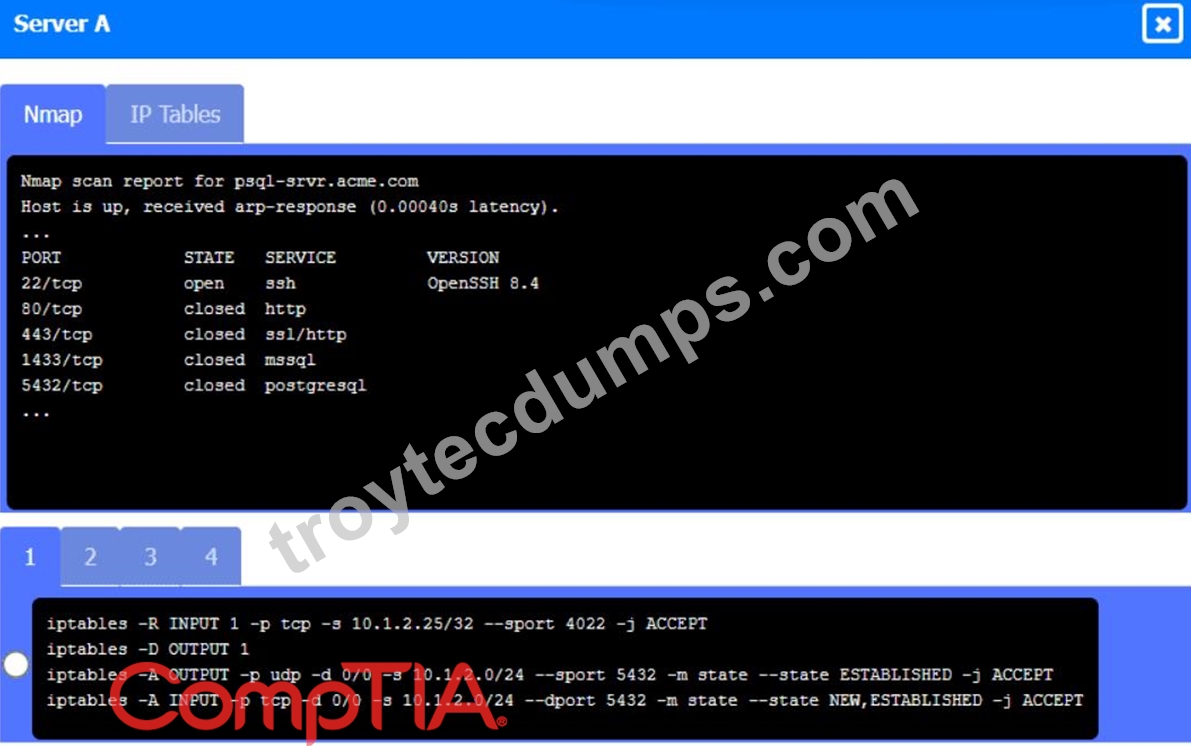



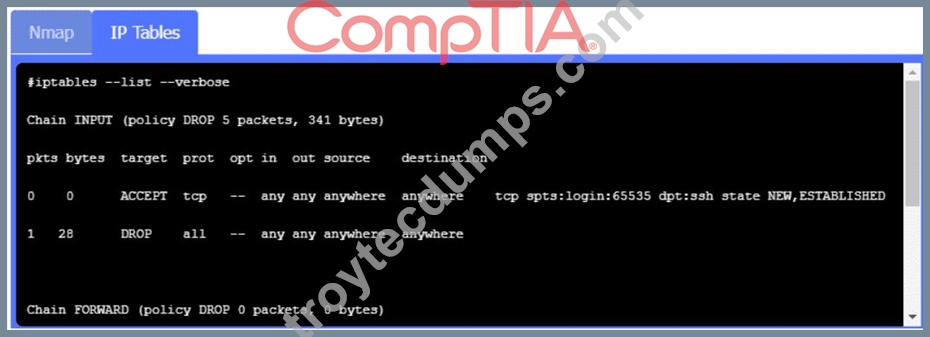
Answer:
Explanation:
See the solution below in Explanation
Explanation:
WAP A: No issue found. The WAP A is configured correctly and meets therequirements.
PC A = Enable host-based firewall to block all traffic
This option will turn off the host-based firewall and allow all traffic to pass through. This will comply with the requirement and also improve the connectivity of PC A to other devices on the network. However, this option will also reduce the security of PC A and make it more vulnerable to attacks. Therefore, it is recommended to use other security measures, such as antivirus, encryption, and password complexity, to protect PC A from potential threats.
Laptop A: Patch management
This option will install the updates that are available for Laptop A and ensure that it has the most recent security patches and bug fixes. This will comply with the requirement and also improve the performance and stability of Laptop A. However, this option may also require a reboot of Laptop A and some downtime during the update process. Therefore, it is recommended to backup any important data and close any open applications before applying the updates.
Switch A: No issue found. The Switch A is configured correctly and meets the requirements.
Switch B: No issue found. The Switch B is configured correctly and meets the requirements.
Laptop B: Disable unneeded services
This option will stop and disable the telnet service that is using port 23 on Laptop B. Telnet is a cleartext service that transmits data in plain text over the network, which exposes it to eavesdropping, interception, and modification by attackers. By disabling the telnet service, you will comply with the requirement and also improve the security of Laptop B. However, this option may also affect the functionality of Laptop B if it needs to use telnet for remote administration or other purposes. Therefore,it is recommended to use a secure alternative to telnet, such as SSH or HTTPS, that encrypts the data in transit.
PC B: Enable disk encryption
This option will encrypt the HDD of PC B using a tool such as BitLocker or VeraCrypt. Disk encryption is a technique that protects data at rest by converting it into an unreadable format that can only be decrypted with a valid key or password. By enabling disk encryption, you will comply with the requirement and also improve the confidentiality and integrity of PC B's data. However, this option may also affect the performance and usability of PC B, as it requires additional processing time and user authentication to access the encrypted data. Therefore, it is recommended to backup any important data and choose a strong key or password before encrypting the disk.
PC C: Disable unneeded services
This option will stop and disable the SSH daemon that is using port 22 on PC C. SSH is a secure service that allows remote access and command execution over an encrypted channel. However, port 22 is thedefault and well-known port for SSH, which makes it a common target for brute-force attacks and port scanning. By disabling the SSH daemon on port 22, you will comply with the requirement and also improve the security of PC C. However, this option may also affect the functionality of PC C if it needs to use SSH for remote administration or other purposes. Therefore, it is recommended to enable the SSH daemon on a different port, such as 4022, by editing the configuration file using the following command:
sudo nano /etc/ssh/sshd_config
Server A. Need to select the following:
NEW QUESTION # 133
......
CAS-005 Braindumps PDF, CompTIA CAS-005 Exam Cram: https://actualtests.troytecdumps.com/CAS-005-troytec-exam-dumps.html