

Oct-2023 Google Cloud-Digital-Leader Certification Real 2023 Mock Exam
Cloud-Digital-Leader Exam Questions and Valid PMP Dumps PDF
Google Cloud Digital Leader certification exam is designed to test your knowledge and expertise in using Google Cloud technologies to drive digital transformation. Google Cloud Digital Leader certification is ideal for professionals who are responsible for leading digital initiatives in their organizations and want to gain a deep understanding of how to leverage Google Cloud tools to drive innovation and growth.
Google Cloud Digital Leader Certification exam is a two-hour exam that features multiple choice and short answer questions. Cloud-Digital-Leader exam is proctored and can be taken from anywhere in the world. To become Google Cloud Digital Leader certified, candidates must pass the certification exam with a score of 80%. Once certified, digital leaders will have access to the Google Cloud Certified community and receive a digital badge that they can display on their LinkedIn profiles or resumes. The Google Cloud Digital Leader Certification is valid for two years, after which, candidates must retake the exam to keep their certification up-to-date.
Google Cloud Digital Leader Certification Exam is an excellent opportunity for professionals who want to showcase their knowledge and skills in cloud computing. With this certification, candidates can demonstrate their expertise in using Google Cloud Platform and its related technologies. It is a valuable certification that can help professionals to advance their careers in cloud computing and digital transformation.
NEW QUESTION # 89
An organization has created an ecommerce website. What data on this website would be considered structured data?
- A. Product descriptions
- B. Product photographs
- C. Product reviews
- D. Product ratings score
Answer: D
Explanation:
Because product ratings are structured because they are numerical scores.
NEW QUESTION # 90
Your organization needs to process large amounts of data from an online application that operates continuously. You do not want to be required to provision infrastructure or create server clusters. What should your organization choose?
- A. Dataflow
- B. Compute Engine with BigQuery
- C. Google Kubernetes Engine with Cloud Bigtable
- D. Dataproc
Answer: B
NEW QUESTION # 91
When an organization adopts cloud technology, how does their total cost of ownership (TCO) shift?
- A. Away from cost management toward capital expenditure
- B. Away from operational expenditure toward capital expenditure
- C. Away from capital expenditure toward operational expenditure
- D. Away from operational expenditure toward cost management
Answer: C
NEW QUESTION # 92
An organization is moving away from an on-premises infrastructure. Instead, they want to create, access, and share information virtually in the cloud.
What should the organization consider?
- A. Replacing their perimeter security with data encryption keys
- B. Optimizing cost-management with a capital expenditure model
- C. Increased hardware capacity when moving their data to the cloud
- D. Built-in security when moving their data to the cloud
Answer: D
NEW QUESTION # 93
Your large and frequently changing organization's user information is stored in an on-premises LDAP database. The database includes user passwords and group and organization membership.
How should your organization provision Google accounts and groups to access Google Cloud resources?
- A. Replicate the LDAP infrastructure on Compute Engine
- B. Use the Identity Platform REST API to create users
- C. Use Google Cloud Directory Sync to create users
- D. Use the Firebase Authentication REST API to create users
Answer: C
Explanation:
You can run a single instance of Google Cloud Directory Sync to synchronize user accounts and groups to Google Cloud.
NEW QUESTION # 94
Your organization wants to migrate its data management solutions to Google Cloud because it needs to dynamically scale up or down and to run transactional SQL queries against historical data at scale. Which Google Cloud product or service should your organization use?
- A. BigQuery
- B. Cloud Bigtable
- C. Cloud Spanner
- D. Pub/Sub
Answer: C
Explanation:
Reference:
Cloud Spanner is a fully-managed, mission-critical relational database service. It is designed to provide a scalable online transaction processing (OLTP) database with high availability and strong consistency at global scale
NEW QUESTION # 95
An organization with hybrid cloud architecture wants to build an application once and be able to run it both on-premises and in their public cloud. Which Google Cloud solution should the organization use?
- A. Cloud Functions
- B. Anthos
- C. App Engine
- D. Compute Engine
Answer: B
Explanation:
Anthos allows organizations to build an application once and run it anywhere.
Migrate directly from VMs, Build, deploy, and optimize apps on GKE, Anthos serverless landing zones and VMs anywhere-simply, flexibly, and securely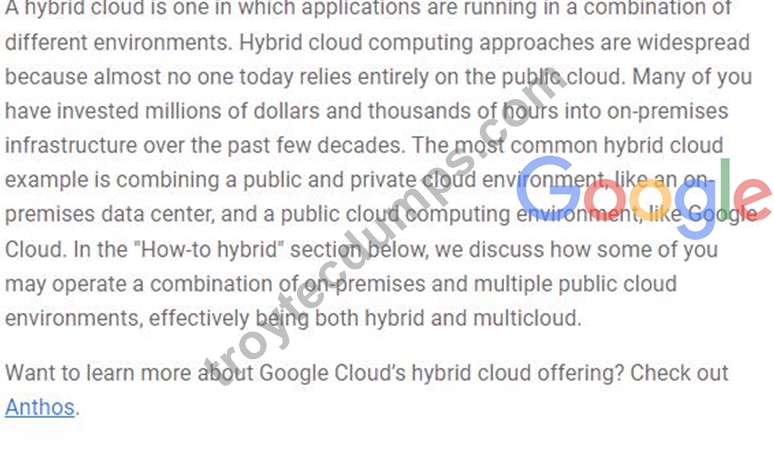
Reference Link- https://cloud.google.com/anthos
NEW QUESTION # 96
Your organization needs to restrict access to a Cloud Storage bucket. Only employees who are based in Canada should be allowed to view the contents.
What is the most effective and efficient way to satisfy this requirement?
- A. Create a group consisting of all Canada-based employees, and give the group access to the bucket
- B. Give each employee who is based in Canada access to the bucket
- C. Configure Google Cloud Armor to allow access to the bucket only from IP addresses based in Canada
- D. Deploy the Cloud Storage bucket to a Google Cloud region in Canada
Answer: B
NEW QUESTION # 97
You are a program manager within a Software as a Service (SaaS) company that offers rendering software for animation studios. Your team needs the ability to allow scenes to be scheduled at will and to be interrupted at any time to restart later. Any individual scene rendering takes less than 12 hours to complete, and there is no service-level agreement (SLA) for the completion time for all scenes. Results will be stored in a global Cloud Storage bucket. The compute resources are not bound to any single geographical location. This software needs to run on Google Cloud in a cost-optimized way.
What should you do?
- A. Deploy the application on Compute Engine using preemptible instances
- B. Start more instances with fewer virtual centralized processing units (vCPUs) instead of fewer instances with more vCPUs
- C. Develop the application so it can run in an unmanaged instance group
- D. Create a reservation for the minimum number of Compute Engine instances you will use
Answer: A
NEW QUESTION # 98
You are working with the head of the IT team and planning the move of computing systems. The questionnaire indicates that they have a reporting application that runs almost 24 hours every day of the week. When there is extra load, it queues up the processing and executes tasks when there is less demand. Which of these compute options would you recommend for them?
- A. Use a serverless option - Cloud Functions
- B. Use a serverless option - App Engine Standard for Flex
- C. Use a server-based option - Compute Engine.
- D. Serverless option - Cloud Run
Answer: A
Explanation:
- Because Compute Engine VMs are the preferred compute option as they are long-running.
NEW QUESTION # 99
Your organization is developing and deploying an application on Google Cloud. Tracking your Google Cloud spending needs to stay as simple as possible.
What should you do to ensure that workloads in the development environment are fully isolated from production workloads?
- A. Put the development resources in their own project
- B. Associate the development resources with their own billing account
- C. Apply a unique tag to development resources
- D. Associate the development resources with their own network
Answer: A
NEW QUESTION # 100
You are a DevOps Engineer in an E-commerce company that sells products globally, across the countries, Customers buy products, add them to carts or check-in stock from different parts of the world with different timestamps, you need to choose a database that can scale globally without any hassle and lots of developer support, it should be consistent across regions, can scale horizontally to support enormous user, automatically replicates, shards and even auto transaction pro-cessing. Which of the following database do you choose?
- A. Cloud Storage.
- B. Cloud Firestore.
- C. Cloud SQL
- D. Cloud Spanner
Answer: D
Explanation:
Cloud Spanner:
Fully managed relational database with unlimited scale, strong consistency, and up to 99.999% availability.
- Get all the benefits of relational semantics and SQL with unlimited scale
- Start at any size and scale with no limits as your needs grow
- Enjoy high availability with zero scheduled downtime and online schema changes
- Deliver high-performance transactions with strong consistency across regions and continents
- Focus on innovation, eliminating manual tasks with capabilities like automatic sharding Automatic sharding Cloud Spanner optimizes performance by automatically sharding the data based on request load and size of the data. As a result, you can spend less time worrying about how to scale your database and instead focus on scaling your business.
Strong transactional consistency
Purpose-built for external, strong, global transactional consistency.
Regional and multi-regional configurations
No matter where your users may be, apps backed by Cloud Spanner can read and write up-to-date strongly consistent data globally Additionally, when running a multi-region instance, your database is able to survive a regional failure, and offers industry-leading 99.999% availability.
Online schema changes with no downtime
Cloud Spanner users can make a schema change, whether it's adding a column or adding an index while serving traffic with zero downtime. Hence you now have the flexibility to adapt your database to your business needs without compromising on the availability of your application.
NEW QUESTION # 101
An organization is training a machine learning model to make predictions.
What could improve the prediction accuracy of their model?
- A. An increase in training data
- B. Higher network bandwidth
- C. An increase in storage capacity
- D. Faster CPU processors
Answer: A
NEW QUESTION # 102
An organization wants a cost-effective relational database.
Which Google Cloud service should the organization use?
- A. Dataflow
- B. BigQuery
- C. Cloud SQL
- D. Cloud Storage
Answer: C
NEW QUESTION # 103
Your organization needs to process large amounts of data from an online application that operates continuously. You do not want to be required to provision infrastructure or create server clusters. What should your organization choose?
- A. Dataflow
- B. Google Kubernetes Engine with Cloud Bigtable
- C. Dataproc
- D. Compute Engine with BigQuery
Answer: A
Explanation:
You do not want to be required to provision infrastructure or create server clusters. Because Unified stream and batch data processing that's serverless, fast, and cost-effective.
Reference link- https://cloud.google.com/dataflow
NEW QUESTION # 104
Your company has been using a shared facility for data storage and will be migrating to Google Cloud. One of the internal applications uses Linux custom images that need to be migrated.
Which Google Cloud product should you use to maintain the custom images?
- A. App Engine flexible environment
- B. Compute Engine
- C. App Engine standard environment
- D. Google Kubernetes Engine
Answer: B
Explanation:
Reference:
A custom image is a boot disk image that you own and control access to. Use custom images for the following tasks:
Import a virtual disk to Compute Engine from your on-premises environment or from VMs that are running on your local workstation or on another cloud platform. You can manually import boot disk images to Compute Engine, but one disk at a time.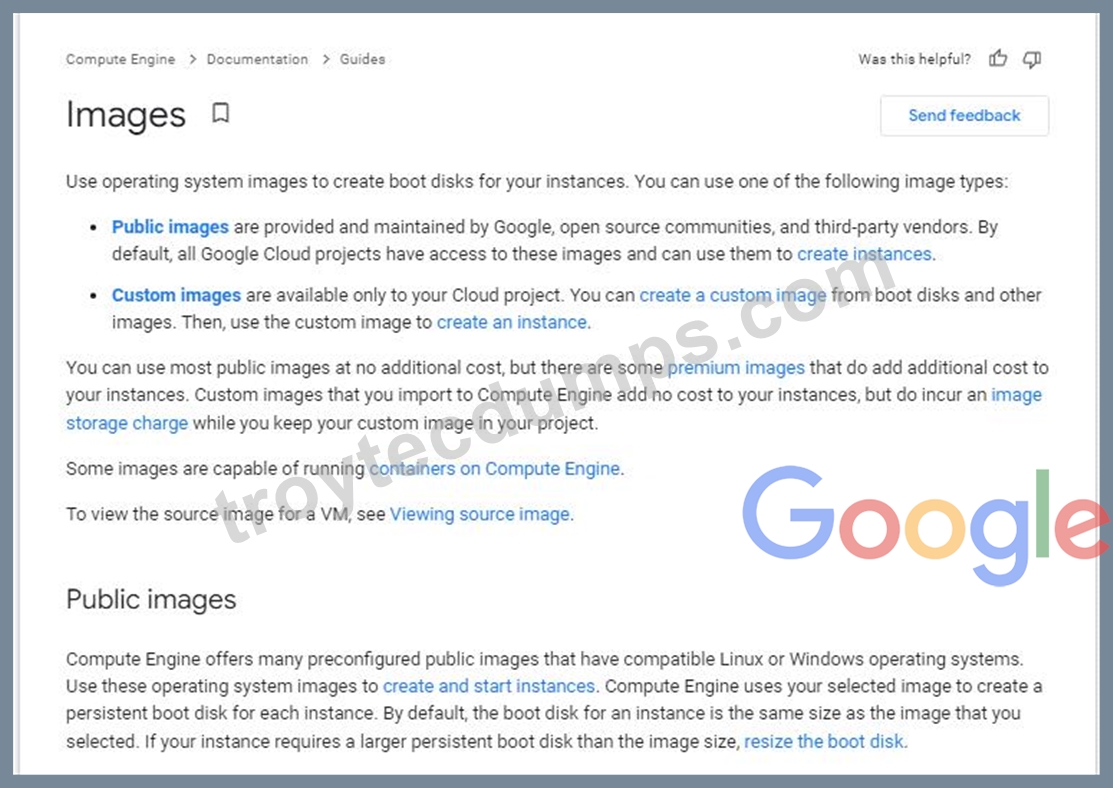
https://cloud.google.com/compute/docs/images
NEW QUESTION # 105
An organization wants to use multiple marketing datasets to forecast user acquisition.
How should they use cloud technology to gain new insights from the data?
- A. Combine the datasets and make predictions using machine learning
- B. Import and selectively archive the datasets in a custom data lake
- C. Separate the datasets and make predictions using machine learning
- D. Import the datasets into a custom data warehouse, and then archive old data
Answer: A
NEW QUESTION # 106
You are storing sensitive information in a Cloud Storage bucket. For legal reasons, you need to be able to record all requests that read any of the stored dat a. You want to make sure you comply with these requirements. What should you do?
- A. Scan the bucket using the Data Loss Prevention API.
- B. Enable the Identity Aware Proxy API on the project.
- C. Enable Data Access audit logs for the Cloud Storage API.
- D. Allow only a single Service Account access to read the data.
Answer: C
Explanation:
Logged information
Your Google Cloud projects contain only the audit logs for resources that are directly within the Cloud project. Other Google Cloud resources, such as folders, organizations, and billing accounts, contain the audit logs for the entity itself.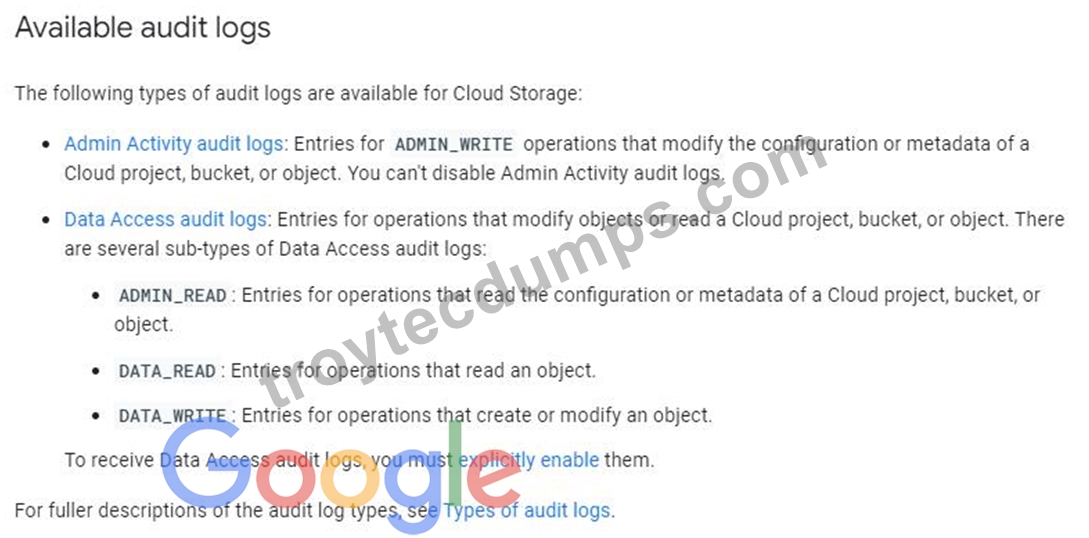
Reference link- https://cloud.google.com/storage/docs/audit-logging
NEW QUESTION # 107
You are a program manager for a team of developers who are building an event-driven application to allow users to follow one another's activities in the app. Each time a user adds himself as a follower of another user, a write occurs in the real-time database.
The developers will develop a lightweight piece of code that can respond to database writes and generate a notification to let the appropriate users know that they have gained new followers. The code should integrate with other cloud services such as Pub/Sub, Firebase, and Cloud APIs to streamline the orchestration process. The application requires a platform that automatically manages underlying infrastructure and scales to zero when there is no activity.
Which primary compute resource should your developers select, given these requirements?
- A. App Engine flexible environment
- B. Google Kubernetes Engine
- C. Compute Engine
- D. Cloud Functions
Answer: D
Explanation:
Reference: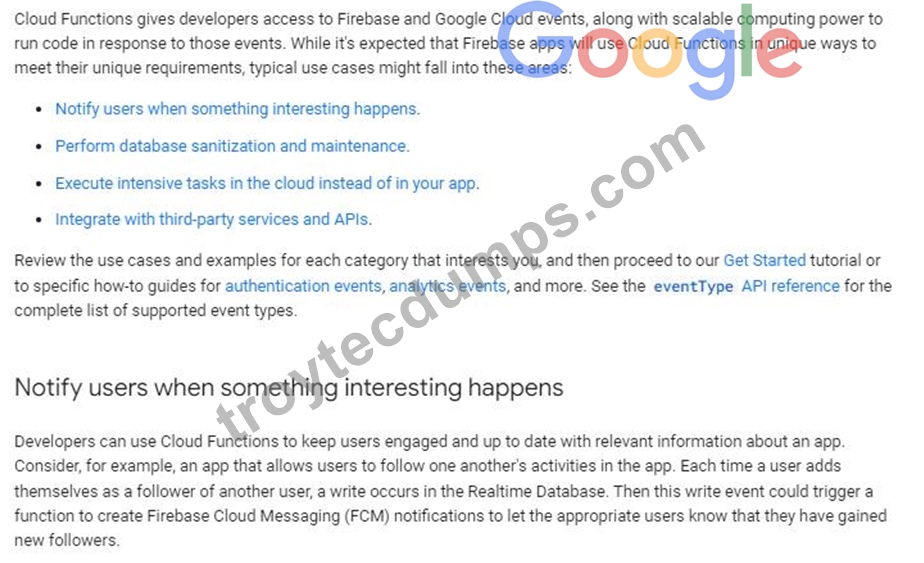
NEW QUESTION # 108
Your organization needs to analyze data in order to gather insights into its daily operations. You only want to pay for the data you store and the queries you perform. Which Google Cloud product should your organization choose for its data analytics warehouse?
- A. Dataproc
- B. BigQuery
- C. Cloud SQL
- D. Cloud Spanner
Answer: B
Explanation:
BigQuery is an enterprise data warehouse for large amounts of relational structured data Serverless, highly scalable, and cost-effective multicloud data warehouse designed for business agility.
NEW QUESTION # 109
An organization is training a machine learning model to predict extreme weather events in their country.
How should they collect data to maximize prediction accuracy?
- A. Collect extreme weather data primarily from at-risk cities
- B. Collect all weather data evenly across all cities
- C. Collect all weather data primarily from at-risk cities
- D. Collect extreme weather data evenly across all cities
Answer: B
Explanation:
Collect all weather data evenly across all cities. Mainly because it seems that the emphasis for data collection for ML is to make sure there are no holes in your data collection.
NEW QUESTION # 110
......
Cloud-Digital-Leader Question Bank: Free PDF Download Recently Updated Questions: https://actualtests.troytecdumps.com/Cloud-Digital-Leader-troytec-exam-dumps.html