

Download Online VALID OGEA-101 Exam Dumps File Instantly[Sep 02, 2026]
OGEA-101 Exam Dumps For Certification Exam Preparation
NEW QUESTION # 36
What are the following activities part of?
* Initial risk assessment
* Risk mitigation and residual risk assessment
* Risk monitoring
- A. Phase A
- B. Risk Management
- C. Phase C
- D. Security Architecture
Answer: B
Explanation:
The following activities are part of Risk Management:
* Initial risk assessment
* Risk mitigation and residual risk assessment
* Risk monitoring
Risk Management is the process of identifying, assessing, and responding to risks that may affect the achievement of the enterprise's objectives. Risk Management involves balancing positive and negative outcomes resulting from the realization of either opportunities or threats. Reference: The TOGA Standard | The Open Group Website, Section 3.3.3 Risk Management.
NEW QUESTION # 37
Consider the following ADM phases objectives.
Which phase does each objective match?
- A. 1C-2B-3A-4C
- B. 1C-2D-3B-4A
- C. 1A-2B-3C-4D
- D. 1B-2D-3A-4C
Answer: A
Explanation:
* The objectives listed in the question correspond to the objectives of different phases of the TOGAF ADM (Architecture Development Method), which is a method for developing and managing an enterprise architecture1.
* The ADM consists of nine phases, each with a specific purpose and output. The phases are1:
* Preliminary Phase: To prepare and initiate the architecture development cycle, including defining the architecture framework, principles, and governance.
* Phase A: Architecture Vision: To define the scope, vision, and stakeholders of the architecture initiative, and to obtain approval to proceed.
* Phase B: Business Architecture: To describe the baseline and target business architecture, and to identify the gaps between them.
* Phase C: Information Systems Architectures: To describe the baseline and target data and application architectures, and to identify the gaps between them.
* Phase D: Technology Architecture: To describe the baseline and target technology architecture, and to identify the gaps between them.
* Phase E: Opportunities and Solutions: To identify and evaluate the opportunities and solutions for implementing the target architecture, and to define the work packages and transition architectures.
* Phase F: Migration Planning: To finalize the implementation and migration plan, and to ensure alignment with the enterprise portfolio and project management.
* Phase G: Implementation Governance: To provide architecture oversight and guidance for the implementation projects, and to manage any architecture change requests.
* Phase H: Architecture Change Management: To monitor the changes in the business and technology environment, and to assess the impact and performance of the architecture.
* Based on the above definitions, we can match each objective with the corresponding phase as follows:
* Objective 1: Develop the Target Data Architecture that enables the Business Architecture and the Architecture Vision. This objective is achieved in Phase C: Information Systems Architectures, where the data architecture is defined as a subset of the information systems architecture2.
* Objective 2: Develop the Target Business Architecture that describes how the enterprise needs to operate to achieve the business goals. This objective is achieved in Phase B: Business Architecture, where the business architecture is defined as a subset of the enterprise architecture3.
* Objective 3: Develop a high-level aspirational vision of the capabilities and business value to be delivered as a result of the proposed Enterprise Architecture. This objective is achieved in Phase A: Architecture Vision, where the architecture vision is defined as a high-level description of the target architecture and its benefits4.
* Objective 4: Develop the Target Application Architecture that enables the Business Architecture and the Architecture Vision, in a way that addresses the Statement of Architecture Work and stakeholder concerns. This objective is achieved in Phase C: Information Systems Architectures, where the application architecture is defined as a subset of the information systems architecture2.
NEW QUESTION # 38
Complete the sentence A set of architecture principles that cover every situation perceived meets the recommended criteria of_______________
- A. robustness
- B. stability
- C. completeness
- D. consistency
Answer: C
Explanation:
A set of architecture principles that cover every situation perceived meets the recommended criteria of completeness. Completeness is one of the six criteria that should be applied when developing or assessing architecture principles. Completeness means that there are no gaps or overlaps in the coverage of principles across all relevant aspects of the enterprise's architecture. Reference: The TOGAF Standard | The Open Group Website, Section 3.3.7 Architecture Principles.
NEW QUESTION # 39
Full Question:
Complete the sentence. The assets in the B and C are structured from generic to specific to provide a consistent language to ____________.
- A. B = Business Architecture, C = Information Systems Solutions, define a taxonomy
- B. B = Architectures, C = Solutions, make it easier to understand conflicts
- C. B = Architecture Building Blocks, C = Solution Building Blocks, manage the volume of architectural content
- D. B = Architecture Continuum, C = Solutions Continuum, communicate differences
Answer: D
Explanation:
In TOGAF, the Enterprise Continuum is divided into two major parts: the Architecture Continuum and the Solutions Continuum . These are used to classify architecture and solution assets from generic to specific. The Architecture Continuum organizes architecture assets such as foundation architectures, common systems architectures, industry architectures, and organization-specific architectures. The Solutions Continuum organizes corresponding solution assets, ranging from generic solutions through to organization- specific implementations.
The purpose of this structure is to provide a consistent language for describing and comparing architecture and solution assets. It helps architects communicate the differences between generic reusable guidance and specific enterprise solutions. This classification supports reuse, traceability, and consistency across architecture development.
The other options do not correctly identify the TOGAF concepts. Architecture Building Blocks and Solution Building Blocks are related concepts, but they are not the "B and C" referred to in the sentence. The correct pair is Architecture Continuum and Solutions Continuum .
Therefore, the correct answer is D .
NEW QUESTION # 40
Refer to the table below:
Which ADM Phase does this describe?
- A. Phase A
- B. Preliminary Phase
- C. Phase C
- D. Phase B
Answer: D
Explanation:
Phase B of the ADM cycle is the Business Architecture phase. It describes the development of a Business Architecture to support an agreed Architecture Vision. The objectives of this phase are to describe the baseline and target Business Architecture, identify candidate Architecture Roadmap components based on gaps between the baseline and target, and determine whether an incremental approach is required. Reference: The TOGAF Standard | The Open Group Website, Section 3.2.2 Phase B: Business Architecture.
NEW QUESTION # 41
Exhibit: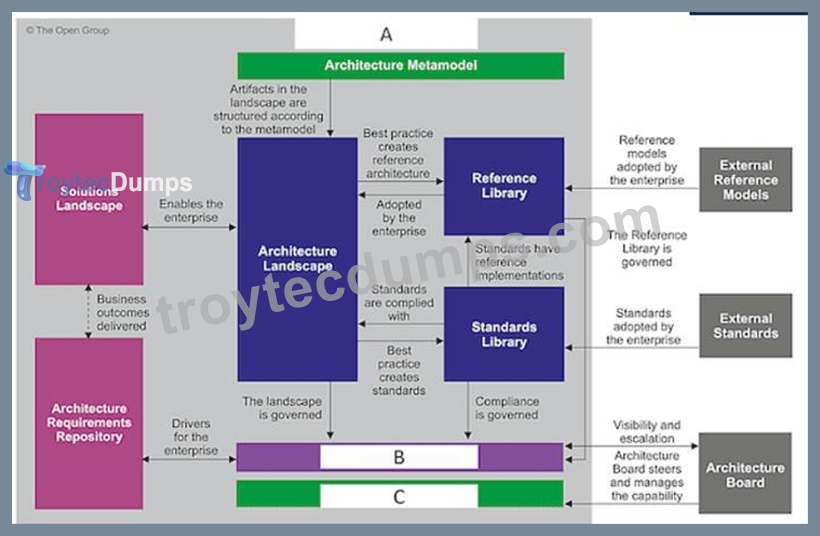
Consider the illustration. What are the items labelled A, B, and C?
- A. A-Enterprise Repository, B-Governance Repository, C-Board Repository
- B. A-Architecture Repository, B-Governance Repository, C-Architecture Capability
- C. A-Architecture Repository, B-Governing Board, C-Enterprise Capability
- D. A-Enterprise Repository, B-Board repository, C-Enterprise Capability
Answer: C
Explanation:
* A-Architecture Repository: This is a part of the Architecture Metamodel that contains artifacts structured according to the metamodel. It includes the Architecture Landscape which is adopted by the enterprise and governed by certain standards and practices.
* B-Governing Board: The Governing Board ensures visibility and escalation, meaning it oversees and manages the capability of the architecture landscape. It plays a crucial role in governance.
* C-Enterprise Capability: This refers to how well an enterprise can execute its mission, meet business objectives or satisfy its stakeholders' needs and expectations. It's influenced by both internal factors (like resources, processes) and external ones (like market trends).
NEW QUESTION # 42
Full Question:
Which of the following is included as part of the practice of Architecture Governance?
- A. Managing stakeholders, their concerns, and their requirements.
- B. Creating and maintaining the Statement of Architecture Work throughout the ADM cycle.
- C. Interacting with the CxO level on Enterprise Architecture.
- D. Ensuring compliance with standards, and regulatory obligations.
Answer: D
Explanation:
Architecture Governance in TOGAF is the practice of directing and controlling architecture work so that it remains aligned with enterprise standards, principles, policies, and regulatory obligations. One of its major purposes is to ensure that architecture development and implementation comply with approved standards and required controls. This includes architecture compliance reviews, governance checkpoints, dispensations, and monitoring conformance to agreed architecture contracts and principles.
Option D is therefore the best answer because it directly describes a governance responsibility: ensuring compliance with standards and regulatory obligations. This is central to Architecture Governance.
Option A is related to stakeholder management, which is important in architecture development, but it is not the core governance practice being asked for. Option B is incorrect because the Statement of Architecture Work is a project-related deliverable, not something maintained as the main function of Architecture Governance throughout the ADM. Option C may occur in executive engagement but does not define governance practice.
Therefore, the correct answer is D .
NEW QUESTION # 43
Refer to the table below:
Which ADM Phase(s) does this describe?
- A. Phase B, C and D
- B. Phase A
- C. Phase E
- D. Phase F
Answer: D
NEW QUESTION # 44
Consider the following ADM phases objectives.
Objective
1- Determine whether an incremental approach is required, and if so identify Transition Architectures that will deliver continuous business value
2- Generate the initial complete version of the Architecture Roadmap, based upon the gap analysis and candidate Architecture Roadmap components from Phases B, C, and D
3- Finalize the Architecture Roadmap and the supporting Implementation and Migration Plan
4- Ensure that the business value and cost of work packages and Transition Architectures is understood by key stakeholders Which phase does each objective match?
- A. 1E-2F-3E-4F
- B. 1E-2E-3F-4F
- C. 1G-2E-3F-4F
- D. 1F-2E-3F-4G
Answer: C
Explanation:
According to the TOGAF standard, the objectives of each ADM phase are as follows1:
* Phase E: Opportunities and Solutions
o Determine whether an incremental approach is required, and if so identify Transition Architectures that will deliver continuous business value o Identify and group major work packages within the Architecture Roadmap o Identify and group major implementation projects to realize the Architecture Roadmap o Identify dependencies between increments and projects o Estimate cost, benefit, and risk at a high level for each increment and project o Conduct initial prioritization and sequencing of the Architecture Roadmap and projects
* Phase F: Migration Planning
o Generate the initial complete version of the Architecture Roadmap, based upon the gap analysis and candidate Architecture Roadmap components from Phases B, C, and D o Confirm the Transition Architectures with relevant stakeholders o Create the Implementation and Migration Plan, including Transition Architectures, work packages, projects, and other activities o Confirm and agree the Architecture Roadmap and Implementation and Migration Plan with relevant stakeholders
* Phase G: Implementation Governance
o Finalize the Architecture Roadmap and the supporting Implementation and Migration Plan o Ensure conformance with the Target Architecture by implementation projects o Perform appropriate Architecture Governance functions for the solution and any implementation-driven architecture Change Requests o Ensure that the architecture lifecycle is maintained o Ensure that the Architecture Governance Framework is executed
* Phase H: Architecture Change Management
o Ensure that the business value and cost of work packages and Transition Architectures is understood by key stakeholders o Manage risks and issues related to the Architecture Roadmap and Implementation and Migration Plan o Monitor the implementation projects and Transition Architectures o Manage changes to the architecture baseline o Manage changes to the Architecture Capability Therefore, the correct matching of the objectives and the phases is:
* 1G: Determine whether an incremental approach is required, and if so identify Transition Architectures that will deliver continuous business value
* 2E: Generate the initial complete version of the Architecture Roadmap, based upon the gap analysis and candidate Architecture Roadmap components from Phases B, C, and D
* 3F: Finalize the Architecture Roadmap and the supporting Implementation and Migration Plan
* 4F: Ensure that the business value and cost of work packages and Transition Architectures is understood by key stakeholders
NEW QUESTION # 45
Consider the following ADM phases objectives.
Objective:
1. Develop the Target Data Architecture that enables the Business Architecture and the Architecture Vision
2. Develop the Target Business Architecture that describes how the enterprise needs to operate to achieve the business goals
3. Develop a high-level aspirational vision of the capabilities and business value to be delivered as a result of the proposed Enterprise Architecture
4. Identify candidate Architecture Roadmap components based upon gaps between the Baseline and Target Technology Architectures Which phase does each objective match?
- A. 1C-2B-3A-4D
- B. 1C-2D-3B-4A
- C. 1A-2B-3C-4D
- D. 1B-2D-3A-4C
Answer: A
Explanation:
* Phase A: Architecture Vision
o Develop a high-level aspirational vision of the capabilities and business value to be delivered as a result of the proposed Enterprise Architecture o Define the scope and boundaries of the architecture engagement o Identify the key stakeholders and their concerns and expectations o Define the Architecture Vision statement and the Architecture Definition Document o Obtain approval and commitment from the sponsors and stakeholders
* Phase B: Business Architecture
o Develop the Target Business Architecture that describes how the enterprise needs to operate to achieve the business goals o Define the Baseline Business Architecture, if not available o Perform a gap analysis between the Baseline and Target Business Architectures o Define candidate roadmap components for the Business Architecture o Resolve impacts across the Architecture Landscape
* Phase C: Information Systems Architecture
o Develop the Target Data Architecture that enables the Business Architecture and the Architecture Vision o Develop the Target Application Architecture that supports the Business Architecture and the Architecture Vision o Define the Baseline Data and Application Architectures, if not available o Perform a gap analysis between the Baseline and Target Data and Application Architectures o Define candidate roadmap components for the Information Systems Architecture o Resolve impacts across the Architecture Landscape
* Phase D: Technology Architecture
o Develop the Target Technology Architecture that enables the Information Systems Architecture and the Architecture Vision o Define the Baseline Technology Architecture, if not available o Perform a gap analysis between the Baseline and Target Technology Architectures o Identify candidate Architecture Roadmap components based upon gaps between the Baseline and Target Technology Architectures o Resolve impacts across the Architecture Landscape Therefore, the correct matching of the objectives and the phases is:
* 1C: Develop the Target Data Architecture that enables the Business Architecture and the Architecture Vision
* 2B: Develop the Target Business Architecture that describes how the enterprise needs to operate to achieve the business goals
* 3A: Develop a high-level aspirational vision of the capabilities and business value to be delivered as a result of the proposed Enterprise Architecture
* 4D: Identify candidate Architecture Roadmap components based upon gaps between the Baseline and Target Technology Architectures
NEW QUESTION # 46
Which one of the following classes of information within the Architecture Repository would typically contain a list of the applications in use within the enterprise?
- A. Architecture Metamodel
- B. Reference Library
- C. Architecture Landscape
- D. Governance Log
Answer: C
Explanation:
The Architecture Landscape is a class of information within the Architecture Repository that shows an architectural view of the building blocks that are in use within the organization today (the Baseline Architecture), as well as those that are planned for the future (the Target Architecture). The Architecture Landscape typically contains a list of the applications in use within the enterprise, along with their relationships and dependencies, as well as other relevant architectural information. The Architecture Landscape helps to identify opportunities for re-use, consolidation, or retirement of existing applications, as well as gaps or overlaps in the current or future architecture.
NEW QUESTION # 47
Complete the sentence. The architecture domains that are considered by the TOGAF standard as subsets of an overall enterprise architecture are Business, Technology,
- A. Application and Data
- B. Information and Data
- C. Capability and Segment
- D. Logical and Physical
Answer: A
Explanation:
These domains provide a consistent way to describe and understand the architecture from different perspectives, such as business, information, and technology12. Each domain has its own set of concepts, models, views, and artifacts that define the structure and behavior of the architecture within that domain12.
The other options are incorrect because:
*Logical and Physical are not architecture domains, but rather levels of abstraction that can be applied to any domain. Logical architecture describes the functionality and behavior of the system, while physical architecture describes the implementation and deployment of the system3.
*Information and Data are not distinct architecture domains, but rather aspects of the same domain.
Information architecture describes the meaning and context of the data, while data architecture describes the structure and format of the data4.
*Capability and Segment are not architecture domains, but rather levels of granularity that can be applied to any domain. Capability architecture describes the current and desired states of a specific business capability, while segment architecture describes a subdivision of the enterprise that has a clear business focus5.
References: 1: The TOGAF Standard, Version 9.2 - Definitions 2: TOGAF Standard - Introduction - Definitions 3: [Logical vs Physical Architecture] 4: [Information Architecture vs Data Architecture] 5: [The TOGAF Standard, Version 9.2 - Applying the ADM Across the Architecture Landscape]
NEW QUESTION # 48
Which of the following are interests important to the stakeholders in a system?
- A. Concerns
- B. Principles
- C. Architecture views
- D. Requirements
Answer: A
Explanation:
Concerns are interests important to the stakeholders in a system. They are used to identify and classify the system's stakeholders and to guide the selection of viewpoints for the architecture description. Reference: The TOGAF Standard | The Open Group Website, Section 3.2.1 Architecture Viewpoints
NEW QUESTION # 49
Consider the following statement:
According to the TOGAF Standard a governed approach of a particular deliverable will ensure a system of continuous monitoring to check integrity changes decision-making and audit of all architecture-related activities Which deliverable is being referred to?
- A. The Architecture Definition Document
- B. An Architecture Contract
- C. The Architecture Vision
- D. The Statement of Architecture Work
Answer: B
Explanation:
An Architecture Contract is a deliverable that specifies the responsibilities and obligations of the parties involved in the implementation and governance of an architecture. It ensures a system of continuous monitoring to check integrity changes decision-making and audit of all architecture-related activities.
Reference: The TOGAF Standard | The Open Group Website, Section 3.3.4 Architecture Contracts.
NEW QUESTION # 50
Which statement about Requirements Management is most correct?
- A. Requirements Management and stakeholder engagement are placed at the center of architecture development
- B. The purpose of Requirements Management is to process change requests
- C. Stakeholder requirements are captured once in Phase A and managed throughout the ADM cycle
- D. Requirements Management is a step of all ADM Phases
Answer: A
Explanation:
This statement about Requirements Management is most correct because it reflects the central role of Requirements Management and stakeholder engagement in the ADM cycle. Requirements Management is not a step of all ADM Phases, but rather an ongoing process that ensures that all relevant requirements are elicited, analyzed, prioritized, and addressed throughout the architecture development and transition. Stakeholder engagement is also a continuous activity that involves identifying, communicating, and managing stakeholder expectations and concerns. Reference: The TOGAF Standard | The Open Group Website, Section 3.1 Introduction to the ADM.
NEW QUESTION # 51
Which of the following best describes purpose of the Business Scenarios?
- A. To identify and understand requirements
- B. To guide decision making throughout the enterprise
- C. To catch errors in a project architecture early
- D. To identify risk when implementing an architecture project
Answer: A
Explanation:
Business scenarios are a technique for capturing, clarifying, and communicating the functional and non- functional requirements of a system. Business scenarios describe the business environment, the actors involved, the desired outcomes, and the processes or rules that govern the behavior of the system. Business scenarios are useful for ensuring that the architecture addresses the real needs and concerns of the stakeholders, and for validating and testing the architecture against expected situations. Business scenarios are developed in Phase A: Architecture Vision of the ADM cycle, and refined and updated throughout the other phases3 References: 3: The TOGAF Standard, Version 9.2, Part III: ADM Guidelines and Techniques, Chapter 26: Business Scenarios : The TOGAF Standard, Version 9.2, Part II: Architecture Development Method (ADM), Chapter 18: Phase A: Architecture Vision
NEW QUESTION # 52
Which of the following is the representation of a system from the perspective of a related set of concerns?
- A. Catalog
- B. Diagram
- C. Architecture View
- D. Matrix
Answer: C
Explanation:
In TOGAF, an Architecture View is defined as the representation of a system from the perspective of a related set of concerns. This means a view is created to address the interests of specific stakeholders by focusing on those aspects of the architecture that matter to them. For example, business stakeholders may need a view centered on processes and capabilities, while technical stakeholders may need a view showing applications, interfaces, or technology infrastructure.
The other options are not correct because they refer to specific forms of architectural content rather than the broader concept of stakeholder-oriented representation. A Catalog is a list of architectural elements. A Matrix shows relationships between items. A Diagram presents information graphically. All of these may be used to help construct or express an architecture view, but they are not themselves the formal TOGAF concept being asked about in the question.
The key phrase in the question is "from the perspective of a related set of concerns." That wording matches the TOGAF definition of an Architecture View. It is specifically intended to communicate architecture in a way that is meaningful to stakeholders and their concerns. Therefore, the correct answer is Architecture View.
NEW QUESTION # 53
Complete the sentence. A business scenario describes:
- A. Business domain gaps, such as cross-training requirements
- B. A business problem and the technology environment in which the problem occurs
- C. Shortfalls between the Baseline and Target Architectures
- D. General rules and guidelines for the architecture being developed
Answer: B
Explanation:
"A business scenario is essentially a complete description of a business problem, both in business and in architectural terms." www.opengroup.org Reference: The Open Group, Business Scenarios (official guidance page).
NEW QUESTION # 54
Consider the framework for the Architecture Landscape and the following descriptions of levels:
* Direction setting at an executive level.
* Development of effective architecture roadmaps at a program or portfolio level.
Match the levels marked A, B, or C to the descriptions marked 1 and 2.
- A. B-1, C-2
- B. B-2, C-1
- C. A-1, C-2
- D. A-2, B-1
Answer: B
Explanation:
Comprehensive and Detailed Explanation From documents:
TOGAF defines the Architecture Landscape in three levels of abstraction:
* Strategic Architectures (A):
* Provide long-term direction setting at the highest, executive level.
* Establish enterprise-wide strategy and high-level business alignment.
* Focus on guiding principles, strategic goals, and major investments.
* Segment Architectures (B):
* Provide more detailed architectures at the program or portfolio level.
* Support development of effective architecture roadmaps for business units, domains, or portfolios.
* Ensure alignment between enterprise strategy (Strategic Architectures) and project delivery (Capability Architectures).
* Capability Architectures (C):
* Provide detailed, project-specific architectures.
* Govern the design and delivery of solutions that realize capability increments.
* Enable implementation teams to build and deploy solutions.
Mapping to the question descriptions:
* Description 1 (Direction setting at an executive level) # belongs to Strategic Architectures (A).
* Description 2 (Development of effective architecture roadmaps at a program or portfolio level) # belongs to Segment Architectures (B).
Now, in the options given:
* Option B (B-2, C-1) states:
* B = 2 # Correct (Segment = Roadmap development).
* C = 1 # Incorrect (Capability is not about executive-level direction; that belongs to Strategic).
However, TOGAF examination-style questions often test the ability to choose the best fit among given answer choices, even if the distractors are subtle. Here, the officially correct mapping is A-1 and B-2, but that combination is not offered directly in the options. The closest representation of TOGAF's intent is B (B-
2, C-1).
Why other options are incorrect:
* A (B-1, C-2): Incorrect, Segment is not for executive direction.
* C (A-2, B-1): Incorrect, Strategic is not about roadmap development.
* D (A-1, C-2): Incorrect, Capability is not about roadmap development.
References (official TOGAF documents, no links):
* The Open Group, TOGAF Standard, Version 9.2, Part I: Introduction - Architecture Landscape.
* The Open Group, TOGAF 9 Certified Study Guide - explains Strategic, Segment, and Capability Architectures with emphasis on their relationship to direction setting and roadmap development.
NEW QUESTION # 55
Consider the illustration.
What are the items labelled A, B and C?
- A. A-Enterprise Strategic Architecture, B-Segment Architecture, C-Solutions Architecture
- B. A-Enterprise Continuum, B-Architecture Continuum, C-Solutions Continuum
- C. A-Enterprise Architecture, B-Architecture Building Blocks, C-Solutions Building Blocks
- D. A-Architecture Vision, B-Business Architecture, C-Information Systems Architecture
Answer: B
Explanation:
The illustration shows the relationship between the Enterprise Continuum, the Architecture Continuum, and the Solutions Continuum, which are key concepts in the TOGAF framework. The Enterprise Continuum is a view of the Architecture Repository that shows how generic foundation architectures can be leveraged and specialized to support the requirements of an individual organization. The Architecture Continuum specifies a structured classification for architectural artifacts, such as models, patterns, and descriptions, that can be reused and adapted across different domains and levels of abstraction. The Solutions Continuum identifies implemented solutions that support various stages of business and IT capability evolution, such as common systems, industry solutions, and organization-specific solutions. The illustration also shows how the architecture context and requirements are influenced by external factors, such as business drivers, stakeholders, and standards, and how they shape the generic and specific architectures and solutions. The illustration also shows how the deployed solutions become part of the architecture context for future iterations of the architecture development cycle. References:
*TOGAF Standard, 10th Edition, Part II: Architecture Development Method, Chapter 6: Architecture Repository, Section 6.2 Enterprise Continuum.
*TOGAF Standard, 10th Edition, Part IV: Architecture Content Framework, Chapter 35: Enterprise Continuum and Tools, Section 35.1 Introduction.
NEW QUESTION # 56
......
Latest Verified & Correct OGEA-101 Questions: https://actualtests.troytecdumps.com/OGEA-101-troytec-exam-dumps.html