

Updated Nov-2025 Test Engine to Practice OGBA-101 Test Questions
OGBA-101 Real Exam Questions Test Engine Dumps Training With 108 Questions
The Open Group OGBA-101 Exam Syllabus Topics:
| Topic | Details |
|---|---|
| Topic 1 |
|
| Topic 2 |
|
| Topic 3 |
|
| Topic 4 |
|
| Topic 5 |
|
| Topic 6 |
|
| Topic 7 |
|
NEW QUESTION # 31
Consider the following graphic illustrating a method supporting the TOGAF ADM.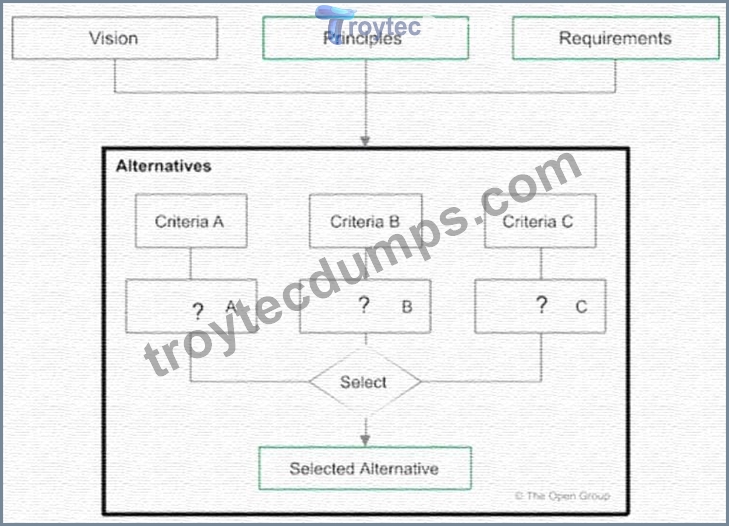
What does the method help identify?
- A. Architecture Solutions
- B. Business Scenarios
- C. Solution Building Blocks
- D. Alternative Target Architectures
Answer: D
Explanation:
The graphic illustrates a method for developing alternative target architectures in Phase E of the TOGAF ADM1. The method involves identifying and evaluating candidate architectures based on criteria such as business value, cost, risk, and feasibility1. The method helps to identify the most suitable architecture solution for the enterprise.
The graphic illustrates a method that supports the TOGAF ADM by identifying and evaluating alternative target architectures. The process begins with a vision, influenced by principles and requirements, leading to the consideration of alternatives. Each alternative is assessed based on different criteria, leading to the selection of the most suitable target architecture. This is consistent with the TOGAF approach of developing a set of potential architectures and then selecting the one that best meets the enterprise's needs.
NEW QUESTION # 32
Which of the following is a benefit of organization mapping?
- A. An organization map highlights inefficiencies and reduces operational costs.
- B. An organization map improves the ability to consume, process, and deliver information.
- C. An organization map can be reused for training and employee development.
- D. An organization map improves strategic planning.
Answer: D
Explanation:
One of the benefits of organization mapping is that it improves strategic planning2. Organization mapping is a technique that can be used to document and visualize the organizational structure and relationships of an enterprise or a part of it2. Organization mapping can help to align the organizational design with the business strategy, goals, and objectives2. Organization mapping can also help to identify the roles, responsibilities, authorities, accountabilities, and dependencies of different organizational entities2. By providing a clear and consistent view of the organizational landscape, organization mapping can enable better informed and more effective decisions for strategic planning.
NEW QUESTION # 33
Consider the following representation of a business model:
Which of the following business models is this an example of?
- A. The Business Model Innovation factory
- B. The Four Box Framework
- C. The Business Model Cube
Answer: B
Explanation:
The provided representation of a business model appears to be a variant of the Business Model Canvas, which is a strategic management template for developing new or documenting existing business models. It is a visual chart with elements describing a firm's value proposition, infrastructure, customers, and finances. The model assists firms in aligning their activities by illustrating potential trade-offs. Since none of the options precisely match the Business Model Canvas and the Four Box Framework is conceptually closest to the Business Model Canvas, option B is the best available answer, albeit not a perfect match.
NEW QUESTION # 34
Consider the diagram.
What are the items labelled A, B and C?
- A. A-Architecture Vision, B-Business Architecture. C-lnformation Systems Architecture
- B. A-Enterprise Continuum, B-Architecture Continuum. C-Solutions Continuum
- C. A-Enterprise Architecture, B-Architecture Building Blocks, C-Solutions Building Blocks
- D. A-Enterprise Strategic Architecture, B-Segment Architecture, C-Solutions Architecture
Answer: B
Explanation:
The diagram shows the Enterprise Continuum, which is a view of the Architecture Repository that provides methods for classifying architecture and solution artifacts as they evolve from generic Foundation Architectures to Organization-Specific Architectures4. The Enterprise Continuum comprises two complementary concepts: the Architecture Continuum and the Solutions Continuum. The Architecture Continuum shows the relationships among foundational frameworks, common system architectures, industry architectures, and enterprisearchitectures4. The Solutions Continuum shows the relationships among foundational solutions, common system solutions, industry solutions, and enterprise solutions4.
NEW QUESTION # 35
Complete the sentence A business capability is_________________________________.
- A. a description of the architectural approach to realize a particular business solution
- B. a representation of an end-to-end collection of business activities
- C. an ability that a business possesses to achieve a specific outcome
- D. a qualitative statement of intent that should be met by the business architecture
Answer: C
Explanation:
A business capability is a conceptual representation that reflects the core abilities or capacities of a business.
It is defined as an intrinsic ability that an organization possesses or can develop to consistently deliver a specific outcome or set of outcomes. Business capabilities abstract away from the organizational structure, processes, and technology to focus on the 'what' the business can do, rather than the 'how' it does it. This concept is fundamental in business architecture as it helps in aligning strategic objectives with operational efficiency.
NEW QUESTION # 36
What component of the Architecture Repository is an architectural representation of SBBs supporting the Architecture Landscape?
- A. Solutions Library
- B. Solutions Landscape
- C. Solutions Continuum
- D. Solutions Repository
Answer: B
Explanation:
The TOGAF Architecture Repository is a key resource for managing architectural artifacts and information. It's structured to hold different types of architectural assets, and the Solutions Landscape plays a specific role within it.
Here's why option C is correct:
Solutions Landscape Definition: This component of the repository specifically houses the Solution Building Blocks (SBBs). SBBs are reusable components that represent a specific function or capability. They can be combined and configured to deliver solutions that meet business needs.
Supporting the Architecture Landscape: The Architecture Landscape provides a broad view of the organization's architecture at specific points in time. The Solutions Landscape supports this by showing how SBBs are deployed or planned to realize the architectures defined in the Architecture Landscape.
Visual Representation: The Solutions Landscape offers a visual representation of the relationships between SBBs and how they contribute to the overall architecture. This helps stakeholders understand the implementation of the architecture.
NEW QUESTION # 37
Which of the following best describes the relationship between business models and business architecture?
- A. Business Architecture articulates the different perspectives and impacts of the business model.
- B. Business models are useful for impact analysis, however Business Architecture is needed for scenario analysis.
- C. Business Architecture provides a conceptual summary view, whereas business models support in-depth analysis.
- D. Business model development is a prerequisite for a Business Architecture development.
Answer: A
Explanation:
The relationship between business models and business architecture in TOGAF can be described as follows:
* Business Models:
* Definition: Business models describe how an organization creates, delivers, and captures value.
They provide a high-level overview of the business, including elements such as value propositions, customer segments, channels, and revenue streams.
* Purpose: Business models are used to understand and analyze the core elements of the business and how they interact to create value.
* Business Architecture:
* Definition: Business architecture provides a detailed view of the business, including its structure, capabilities, processes, and information. It articulates how the business operates and supports the business model.
* Purpose: Business architecture translates the high-level view of the business model into detailed architectural views and artifacts. It ensures that the architecture aligns with the business strategy and supports the execution of the business model.
* Relationship:
* Articulation of Perspectives: Business architecture articulates the different perspectives and impacts of the business model by providing detailed views of the business components that support the model. This includes defining the necessary capabilities, processes, and organizational structures.
* Alignment and Execution: Business architecture ensures that the architecture aligns with the business model and supports its execution. It translates the strategic intent of the business model into actionable and implementable architectural components.
* TOGAF References:
* Phase B: Business Architecture: This phase involves developing a detailed business architecture that aligns with and supports the business model. It includes identifying and defining business capabilities, processes, and organizational structures.
* Strategic Planning: TOGAF emphasizes the importance of aligning business architecture with business strategy and models to ensure that the architecture supports the overall business goals.
* Benefits:
* Comprehensive Understanding: By articulating the different perspectives and impacts of the business model, business architecture provides a comprehensive understanding of how the business operates and delivers value.
* Strategic Alignment: Ensures that the architecture is aligned with the business strategy and supports the execution of the business model, leading to better business outcomes.
In summary, business architecture articulates the different perspectives and impacts of the business model by providing detailed views of the business components that support the model, ensuring alignment and effective execution of the business strategy.
NEW QUESTION # 38
Consider the following example value stream:
What does this show?
- A. A series of five subprocesses that makeup the value stream
- B. The service "Acquire Retail Product" consists of five events
- C. A decomposition into a sequence of value-creating stages.
- D. The value stream consists of five business capabilities.
Answer: C
Explanation:
The example value stream shown, labeled "Acquire Retail Product," represents a decomposition into a sequence of stages that collectively create value. Each stage, such as "Advertise Channels," "Display Products," "Enable Selection," "Process Payment," and "Deliver Product(s)," is a step in the overall process that contributes to the final outcome, which in this case is the acquisition of a retail product by the customer.
Value streams are utilized in business architecture to model the flow of value through an organization from the initial customer demand to the final delivery of the product or service.
NEW QUESTION # 39
Which of the following best describes the relationship between business models and business architecture?
- A. Business Architecture breaks a business model down into the core functional elements that describe how the business works.
- B. Business models are useful for impact analysis, however Business Architecture is needed for scenario analysis.
- C. Business Architecture provides a conceptual summary view, whereas business models support in-depth analysis.
- D. Business model development is a prerequisite for a Business Architecture development.
Answer: A
Explanation:
A business model describes how an organization creates, delivers, and captures value for its stakeholders3. A business architecture breaks a business model down into the core functional elements that describe how the business works, such as the value proposition, the customer segments, the channels, the revenue streams, the cost structure, the key resources, the key activities, and the key partnerships3.
NEW QUESTION # 40
Which of the following is a benefit of value streams and value stream mapping?
- A. Value streams highlight the value of individual work packages needed to develop the business architecture.
- B. Value streams help to identify value, duplication, and redundancy across the enterprise.
- C. Value streams help to ensure that investments and project initiatives are prioritized and funded at an appropriate level commensurate with their value.
- D. Value streams provide a framework for more effective business requirements analysis, case management, and solution design.
Answer: D
Explanation:
According to the TOGAF Business Architecture Guide, value streams play a key role in providing a structured framework that supports more effective analysis of business requirements, case management, and solution design. Value streams offer a high-level, customer-centric view of how value flows through the organization, which helps in aligning business requirements and ensuring solutions are well-targeted to meet those requirements.
Role of Value Streams in Business Requirements Analysis
Value streams help stakeholders understand the key stages and outcomes that deliver value to customers or stakeholders. This framework facilitates a clear alignment between business requirements and the value outcomes each requirement supports. By mapping requirements to specific value stream stages, architects can ensure that requirements are directly tied to business outcomes.
Supporting Case Management
Value streams also provide a structured approach for managing various business cases. By identifying key stages in the value creation process, value streams help in evaluating and prioritizing cases based on their impact on value delivery. This structured approach enhances case management by focusing on value, efficiency, and alignment with organizational goals.
Enhancing Solution Design
Solution design is more effective when informed by a value stream view, as it allows architects to focus on delivering value at each stage of the process. By understanding the flow of value, architects and solution designers can ensure that technology, processes, and capabilities are aligned to support the most critical aspects of the value stream. This alignment optimizes solution design to meet specific business needs more effectively.
Why Option B is Correct
The TOGAF Business Architecture Guide explicitly states that value streams provide a framework for business requirements analysis, case management, and solution design. This insight indicates that value streams are instrumental in ensuring that these elements are aligned with how value is delivered within the organization.
Why Other Options are Incorrect:
Option A (Identify value, duplication, and redundancy):
While value streams can provide insights into operational efficiency, they are not primarily focused on identifying duplication and redundancy across the enterprise. Instead, this aspect is typically covered by detailed process mapping or capability assessments.
Option C (Highlighting value of individual work packages):
Value streams do not emphasize individual work packages but rather focus on the overall flow of value. Work packages are more granular and usually defined during implementation and migration planning.
Option D (Ensuring investment prioritization):
Investment prioritization is more closely associated with portfolio management rather than value stream mapping. Although value streams inform decision-making, they do not directly handle funding prioritization.
Conclusion:
The correct answer is B because value streams provide a framework that directly supports business requirements analysis, case management, and solution design, as outlined in the TOGAF Business Architecture Guide.
Reference:
TOGAF Business Architecture Guide, Value Streams Section
NEW QUESTION # 41
Exhibit.
Consider the diagram of an architecture development cycle.
Select the correct phase names corresponding to the labels 1, 2 and 3?
- A. 1 Requirements Management - 2 Implementation Governance - 3 Preliminary
- B. 1 Continuous Improvement - 2 Migration Planning - 3 Architecture Vision
- C. 1 Requirements Management - 2 Change Management - 3 Strategy
- D. 1 Architecture Governance - 2 Implementation Governance - 3 Preliminary
Answer: A
Explanation:
The diagram of an architecture development cycle shows three phases of the TOGAF ADM. The correct phase names corresponding to the labels 1, 2 and 3 are Requirements Management, Implementation Governance, and Preliminary respectively3. These phases are described as follows:
* Requirements Management (label 1): This phase provides a process for managing architecture requirements throughout the ADM cycle3. It ensures that requirements are captured, stored, prioritized, and addressed by relevant ADM phases3. It also ensures that requirements are validated and updated as necessary3.
* Implementation Governance (label 2): This phase provides a process for ensuring that the implementation projects conform to the defined architecture3. It involves establishing an implementation governance model, defining architecture contracts and compliance reviews, and monitoring and supporting the implementation projects3.
* Preliminary (label 3): This phase provides a process for preparing and planning the architecture project3. It involves defining the scope and vision of the project, customizing the ADM process and content framework, defining principles and governance structures, and evaluating the enterprise architecture maturity and readiness3.
NEW QUESTION # 42
What is presented as "striking a balance between positive and negative outcomes resulting from the realization of either opportunities or threats"?
- A. Risk Management
- B. Architecture Security
- C. Agile development
- D. Transition Management
Answer: A
Explanation:
Risk management in TOGAF involves balancing positive and negative outcomes resulting from the realization of either opportunities or threats. Here's a detailed explanation:
* Definition of Risk Management:
* Risk Management: The process of identifying, assessing, and controlling risks arising from operational factors and making decisions that balance risk costs with benefits.
* Balancing Outcomes:
* Opportunities and Threats: Risk management aims to strike a balance between the positive outcomes (opportunities) and negative outcomes (threats) of different scenarios. This involves assessing the potential benefits and drawbacks of various actions and decisions.
* Decision-Making: Effective risk management supports informed decision-making by considering the potential impacts of risks and opportunities on the organization's objectives.
* TOGAF References:
* Architecture Risk Management: TOGAF includes guidelines for managing risks associated with architecture development. This involves identifying risks early in the ADM phases and continuously monitoring and mitigating them throughout the architecture lifecycle.
* Phase F: Migration Planning: During this phase, risk management is crucial for planning the transition from the current state to the target architecture. It ensures that risks are identified, assessed, and mitigated to ensure a smooth transition.
* Benefits:
* Minimizing Negative Impacts: By effectively managing risks, organizations can minimize the negative impacts of threats and enhance the positive outcomes of opportunities.
* Enhancing Resilience: Risk management helps in building organizational resilience by preparing for potential disruptions and ensuring continuity of operations.
In summary, risk management is about striking a balance between positive and negative outcomes resulting from the realization of either opportunities or threats, supporting informed decision-making and enhancing organizational resilience.
NEW QUESTION # 43
Which of the following best describes "value" in the context of Business Architecture?
- A. The benefit of something.
- B. The monetary worth of something.
- C. The market price of something.
- D. A numerical quantity assigned to something.
Answer: A
Explanation:
In Business Architecture, "value" refers to the benefit provided to stakeholders, aligning with TOGAF's goal to capture and deliver value in business processes and capabilities. Business value is viewed as outcomes or improvements that meet stakeholder needs, rather than purely financial or numerical metrics.
References: TOGAF Business Architecture Value Definition.
In the context of Business Architecture, "value" is broadly defined as thebenefitthat something provides to stakeholders. This benefit can take many forms, including:
* Financial value:Increased revenue, reduced costs, improved profitability.
* Customer value:Enhanced customer satisfaction, improved customer experience, increased customer loyalty.
* Operational value:Increased efficiency, improved productivity, reduced risk.
* Social value:Positive impact on society, environmental sustainability, ethical practices.
The key point is that value issubjectiveand depends on the perspective of the stakeholder. What is valuable to one stakeholder may not be as valuable to another. Therefore, understanding stakeholder values is crucial for effective business architecture.
NEW QUESTION # 44
Which of the following Business Architecture concepts should the architect examine and search for when developing the Architecture Vision?
- A. Architecture Continuum, Architecture Repository
- B. Implementation Factor Catalog, Business Value Assessment Matrix
- C. Architecture Principles, Business Drivers
- D. Value Streams, Business Capabilities
Answer: D
Explanation:
When developing the Architecture Vision, it is essential for the architect to examine and search for Value Streams and Business Capabilities. Here's a detailed explanation:
* Architecture Vision Phase (Phase A):
* The Architecture Vision phase sets the overall direction and context for the architecture project. It defines the scope and vision for the future state architecture and establishes a shared understanding among stakeholders.
* Value Streams:
* Definition: Value streams represent the end-to-end set of activities that deliver value to customers or stakeholders. They provide a high-level view of how value is created and delivered within the organization.
* Importance: Understanding value streams helps in aligning the architecture with business processes and ensuring that the architecture supports the delivery of value.
* Business Capabilities:
* Definition: Business capabilities define what an organization needs to be able to do to achieve its business objectives. They represent the core functions or abilities of the organization.
* Importance: Identifying and understanding business capabilities is crucial for ensuring that the architecture addresses the critical functions of the business and supports its strategic goals.
* TOGAF ADM References:
* Phase A: Architecture Vision: In this phase, the architect examines value streams and business capabilities to understand the current state and define the desired future state. This helps in creating an architecture vision that is aligned with business objectives and supports value creation.
* Strategic Planning: Value streams and business capabilities provide a foundation for strategic planning, ensuring that the architecture is designed to support key business activities and capabilities.
In summary, when developing the Architecture Vision, examining value streams and business capabilities is essential for understanding how the organization delivers value and ensuring that the architecture supports critical business functions and strategic objectives.
NEW QUESTION # 45
In what TOGAF ADM phase is the organization map linked built out with the detail and relationships to overviews in order to understand the needs of the organization?
- A. Preliminary Phase
- B. Phase A
- C. Phase E
- D. Phase B
Answer: B
Explanation:
Phase A (Architecture Vision) of the TOGAF ADM builds out initial organizational maps to understand high-level organizational needs and link them to architecture goals. This step provides foundational insight that informs subsequent phases, particularly for stakeholder alignment.
Reference:
In TOGAF, Phase A (Architecture Vision) is where the organization map is developed in detail and linked to overviews to understand the organizational needs. This phase focuses on:
Defining the scope of the architecture: This includes identifying the parts of the organization that will be affected by the architecture and the timeframe for the architecture development.
Identifying stakeholders and their concerns: Understanding the needs and expectations of different stakeholders is crucial for developing an architecture that meets their requirements.
Creating a high-level architecture vision: This vision outlines the desired future state of the architecture and how it will support the organization's strategic goals.
NEW QUESTION # 46
Consider the diagram.
What are the items labelled A, B and C?
- A. A-Architecture Vision, B-Business Architecture. C-lnformation Systems Architecture
- B. A-Enterprise Continuum, B-Architecture Continuum. C-Solutions Continuum
- C. A-Enterprise Architecture, B-Architecture Building Blocks, C-Solutions Building Blocks
- D. A-Enterprise Strategic Architecture, B-Segment Architecture, C-Solutions Architecture
Answer: B
Explanation:
The diagram shows the Enterprise Continuum, which is a view of the Architecture Repository that provides methods for classifying architecture and solution artifacts as they evolve from generic Foundation Architectures to Organization-Specific Architectures4. The Enterprise Continuum comprises two complementary concepts: the Architecture Continuum and the Solutions Continuum. The Architecture Continuum shows the relationships among foundational frameworks, common system architectures, industry architectures, and enterprise architectures4. The Solutions Continuum shows the relationships among foundational solutions, common system solutions, industry solutions, and enterprise solutions4.
NEW QUESTION # 47
Which of the following is a benefit of information mapping?
- A. It provides a basis to support decision-making throughout the business.
- B. It enables improved business process integration.
- C. It provides a framework for effective business requirements analysis.
- D. It highlights information requirements not addressed by a business architecture.
Answer: A
Explanation:
One of the benefits of information mapping is that it provides a basis to support decision-making throughout the business1. Information mapping is a technique that can be used to document and visualize the information concepts and their relationships that are relevant for the business1. Information mapping can help to identify the information needs, sources, flows, quality, and value of the business, as well as the gaps, issues, and opportunities for improvement1. By providing a clear and consistent view of the information landscape, information mapping can enable better informed and more effective decisions at all levels of the business.
NEW QUESTION # 48
......
OGBA-101 Actual Questions Answers PDF 100% Cover Real Exam Questions: https://actualtests.troytecdumps.com/OGBA-101-troytec-exam-dumps.html